Money Down a Rathole
VRE and Norfolk ‘Tide’ are big wastes of tax dollars.
by Ken Reid
“The Tide,” the cute name given to the 7.4 mile-Norfolk light rail now entering its 15th year of service, was dubbed in an August expose the “Worst LRT in America.”
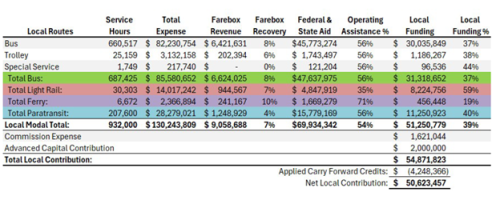
According to Hampton Roads Transit’s 2026 budget, the annual cost of operating the Tide is $14 million and “local funding” (which means funds from HRT and City of Norfolk taxpayers) totals is $8.2 million while $4.847 million comes from federal and state sources. Only $944,567 are from fares.
This means the “farebox recovery” (to use transit parlance) is only 7 percent!!! Many of the Hampton Roads Transit buses have but 3 to 12 percent farebox recovery, according to reports, but operating costs for buses are about 50 percent less than the rail.
Monthly Tide ridership is high in the summer – about 3,000 a day — likely because Norfolk Tides minor league games get a number of passengers, but it was only about 2,200 a day in November 2025.
Assuming 2,200 riders per day, Norfolk and state taxpayers are paying $6,363 a year per passenger ($10.6 million divided by 2,000, 365 days a year) — meaning, it would be cheaper to buy each passenger a used car – or put the money into police, schools or other needy services.
Hampton Roads Transit FY 2025 Operating Budget
The light rail was the wonderchild of a few Norfolk politicians who thought it would boost downtown economic development and take cars off the road. It has not done either. I lived in Norfolk for four years and its downtown was on the way to recovery before rail came along.
Planners hoped the rail would go all the way to the shores of Virginia Beach and still live with the fiction that had voters in Virginia Beach not killed it twice in 1999 and 2016 referenda, the Tide would have more ridership. Not so.
Hampton Roads is a spread-out region that developed mostly in the automobile era and I-264, the main east-west expressway between Norfolk and the Beach, works very well. City residents did the right thing to kill it, but in Northern Virginia, Virginia Railway Express (VRE) is almost as bad of a boondoggle.
Established in 1992 to provide rail transit from Fredericksburg to job centers in Alexandria, Arlington and downtown D.C., plus a line from Manassas, VRE ridership is down from pre-COVID ridership of 19,000 daily to just 11,500 combined on both lines. But because that number is bi-directional, into D.C. in the morning and back to the ‘burbs in the evening, in reality, VRE only has about 5,400 actual users – mostly the Fredericksburg line (3,300 vs. 2,100 for the Manassas line.
In contrast, the Washington Metrorail has recovered ridership from a COVID low of 325,000 daily to about 660,000 average weekday – mainly attributable to President Trump in January ordering all remote federal workers back to their offices.
VRE does not seem to have benefited from the president’s order, perhaps because of two major highway expansions post-COVID that offer faster speeds for commuters – the I-66 express lanes outside the 495 Beltway, which opened in 2022, and the Fredericksburg extension of the I-95 toll lanes that opened in 2024.
A 2024 VRE study acknowledged: “The perception and/or reality that it’s faster to drive than take transit is a real barrier to use.”
However, VRE management, who report to three different commissions of local politician decision-makers, has made no cutback in service, nor have the local jurisdictions cut back on capital funding.
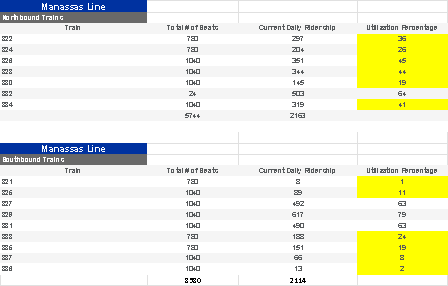
For example, one Manassas Line train has 1,040 seats, but only 145 seats are taken. A southbound train has 780 seats, but only 8 passengers a day (see table). Only four of 16 Manassas Line trains have more than half of their seats filled; the Fredericksburg Line’s 16 trains are mostly over 50 percent full, but none close to 100 percent.
Ande, the main funding arm, the Northern Virginia Transportation Authority (NVTA), just can’t say “no.”
NVTA’s fiscal 2026 spending plan proposes $51 million for VRE “improvements,” totaling $145 million over time
This includes $30 million for a Manassas Park station, and $16 million for a Rippon Station improvement, both in Prince William County (see table). VRE is still wasting money to extend the system to Gainesville – which is right on I-66 – despite the cost and low utility potential.
What’s even sadder, is all these projects are listed as “underway,” which means they could be wending their way toward construction because once contracts are issued, they cannot be revoked.

In terms of operating costs, farebox revenue is projected to drop from $23 million to $20 million from FY 2025 to FY 2026, VRE reported. Annual operating expenses are $104 million, including $18 million in tax subsidies from Fairfax, Prince William, Spotsylvania, Stafford counties and cities like Manassas and Alexandria.
As such, VRE has about a 21 percent farebox recovery and is costing federal, state and local taxpayers about $7,600 a year per passenger. I won’t advocate buying each a used car because VRE passengers are largely upper- income people with autos unlike many Tide passengers, who are lower income.
What would be more economical than VRE, and provide faster connectivity for commuters, is expanding express buses on both the I-66 and I-95 express lanes in lieu of rail. There already are express buses from Prince William County to DC in the I-95 corridor, which also could be eating into VRE ridership.
But politics always interferes with transit decision making. Under the landmark 2013 state law that created funding for NVTA, money comes from a portion of the local sales tax, the regional grantor’s tax on real estate sales, and taxes on hotel rooms and rental vehicles. Each jurisdiction in the NVTA service area gets 30 percent of the money for local projects and the authority is supposed to use a ranking system to determine the sources for the 70 percent of the remainder funds.
So, if the City of Manassas Park wants to use its money on a VRE station, NVTA obliges. NVTA is comprised largely of Northern Virginia county supervisors and city councilmembers, and these politicians have jerry-rigged the criteria for funding over the years so traffic congestion relief is no longer the main factor for getting the 70 percent money.
In addition, once a train line goes in, it is next to impossible to shut it down or to close underused stations. There are plenty of consultants and contractors eager to keep spending money on VRE and Norfolk light rail.
Meanwhile the D.C. region is back to being in the top 3 of major U.S. metro areas for traffic congestion and 50% of NVTA’s money goes into transit or bike/pedestrian trails, which is at best 15% of all commuter trips these days in Northern Virginia.
Ken Reid, a resident of the Tysons/Falls Church area in Fairfax County, served 10 years in local elected office in Loudoun County, including four years on the Board of Supervisors, where he served on the Northern Virginia Transportation Commission and as Leesburg Town Council representative to the NVTA Advisory Committee.
Republished with permission from Bacon’s Rebellion.