BREAKING: Virginia Judge Stops Democrat Gerrymandering Power Grab
by Victoria Manning
Virginia Democrats rewrote the rules, rushed the clock, and gerrymandered the map—now the state supreme court will get the final say.
Tazewell County Circuit Court Judge Jack Hurley blocked election certification just one day after Virginia narrowly passed a gerrymandering referendum that heavily favors Democrats.
On April 22, Judge Hurley found the referendum violated multiple aspects of the state constitution and legislative procedures. This decision will be appealed, likely to the Virginia Supreme Court, but until then the department of elections can take no action to implement the gerrymandered congressional districts.
Former Virginia Attorney General and National Chairman of the Election Transparency Initiative, Ken Cuccinelli said, "The 'yes' vote has won VA's redistricting referendum, but the legal fight is just beginning." Cuccinelli told Restoration News he is cautiously optimistic "because the General Assembly so brazenly violated so many different constitutional requirements, that it is likely that the Virginia Supreme Court will void the referendum."
Virginia Democrats are facing legal and political backlash after ramming through a redistricting amendment that trampled the state constitution and defied voters.
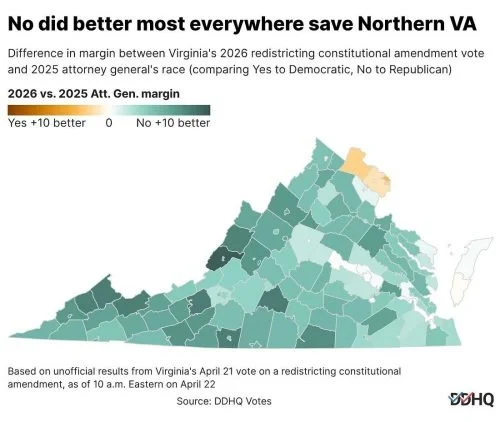
The ballot referendum to redistrict Virginia would hand four of five Republican congressional districts to Democrats. That effort only won by three points, 51–48 (unofficial results) despite over $100 million of untraceable dark-money rolling in for the Democrats "Vote Yes" campaign. They won by only 100,000 votes state-wide.
In 2020, voters overwhelmingly approved a constitutional amendment, 66–24 percent, to have a bipartisan redistricting commission draw congressional district lines. The outcome was six Democrat and 5 Republican districts—a balanced map representative of the political make-up of the state. In an effort to cede control from Republicans in the U.S. House of Representatives, Virginia Democrats ignored the will of 66 percent of the voters.
Virginia Democrat Governor Abigail Spanberger won her election by pretending to be a moderate, garnering an overwhelming 15-point victory just five months ago in November 2025. On the campaign trail, Spanberger told voters on Aug. 25, 2025 that she "had no plans to redistrict Virginia." But shortly after she won she signed off on the constitutional amendment to gerrymander the state.
Virginians have quickly discovered Spanberger can't be trusted. The Republican turnout on Apr. 21 was larger than the gubernatorial election—that's unusual for a special election and a sign that Virginians aren't pleased with the new leadership.
The battle isn't over though—multiple court challenges remain to be decided by the state's Supreme Court.
There are at least five constitutional issues that could be challenged, some of which are awaiting a hearing to be set by Virginia's Supreme Court.
Special Session Passage
The constitution only permits the legislature to convene under defined circumstances for limited periods of time. Yet the Democrat-led legislature called a special session on October 31, 2025—-claiming it was an extension of a previously called special budget session. Expanding the special session to include a constitutional amendment required a two-thirds vote that did not occur.
A Tazewell County judge found that action to be "void, ab initio"—meaning the special session vote was invalid. This decision was appealed to the State Supreme Court who determined the election would take place, but they would consider legal challenges after the election.
Lack of Intervening Election
Under Virginia's constitution, an amendment must pass the General Assembly twice with an intervening election in between. When the Democrats passed the first measure on Oct. 3, 2025, voting for the House of Delegates' election had already begun on Sept. 19th. The constitution requires that the second passage must take place "after the next general election of members of the House of Delegate" which would be in 2027. Democrats ignored that requirement and passed the second measure in February 2026.
The intervening election requirement exists to give voters a chance to weigh how their delegate voted before deciding whether to send them back to Richmond. Since millions of voters across the state had already cast their votes, Democrats stripped Virginians of that constitutional protection before they even knew it was gone.
Ninety-Day Requirement
The Virginia Constitution requires amendments to be submitted to voters no sooner than ninety days after final passage. The final passage of the second bill for the redistricting amendment was Feb. 6, 2026. Early voting began less than thirty days later on March 6.
Challenge to Proposed Maps: Contiguity Requirement
The Virginia Constitution states, "Every electoral district shall be composed of contiguous and compact territory and shall be so constituted as to give, as nearly as is practicable, representation in proportion to the population of the district." The proposed maps are clearly not contiguous or compact, nor are they representative of the population of the district.
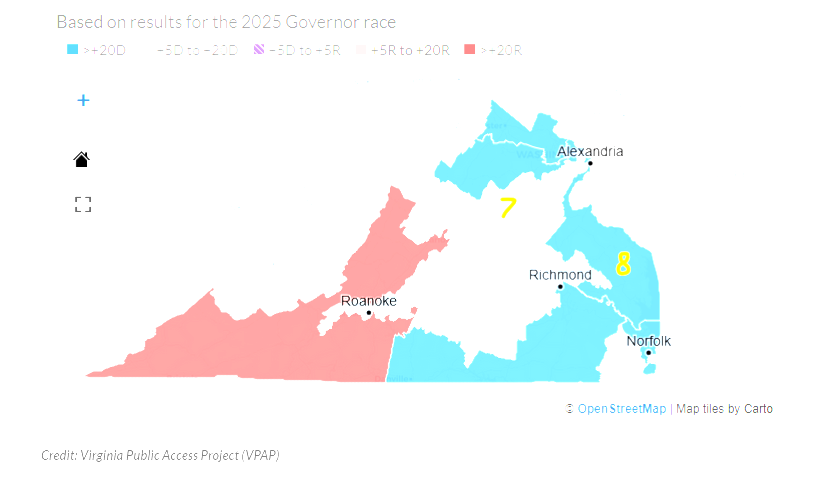
District 7 resembles a lobster and would have very rural Republican Rockingham County in Virginia's western farm country sharing a Representative with the northeastern bright blue cities. District 8 would include Gloucester, a small southeastern fishing town, along with the city of Alexandria three hours away just outside D.C.
Failure to Post Notice of Amendment
Virginia Code 30-13 requires the Clerk of the House of Delegates to distribute proposed amendments to the constitution to the clerk of circuit court of each county and city. The proposed amendments must be posted at the front door of the courthouse "not later than three months prior to the next ensuing general election of members of the House of Delegates."
Not only were those public notices not posted, in March the Democrats in the General Assembly attempted to erase that law. They passed legislation to repeal Code 30-13 and to make the repeal retroactive to 1971. Yet the effective date of the repeal isn't until July 1, 2026.
Court Actions Imminent
There are multiple pending cases before the Virginia State Supreme Court who declined to issue an injunction before the election. The court reasoned they did not want to stop the holding of an election but would still hear the cases afterward. This was their statement in a case brought by the Republican National Committee (RNC):
For over a century, we have recognized the "well settled principle regulating the jurisdiction of courts of equity that such courts will not, with few exceptions, enjoin the holding of an election, or interfere, by its process of injunction, with the holding of an election." This principle does not mean that judicial review of allegedly unlawful elections ceases to exist. It only means that, as a prudential matter, Virginia courts generally should not prematurely enjoin an upcoming election.
There are two additional cases: McDougle v. Nardo and McGuire v. Virginia State Board of Elections. The McDougle case, brought by two state Senators and a Delegate, challenges the legality of the process used by the legislature to amend the Constitution. McGuire was brought forward by Congressmen John McGuire and Rob Wittman challenging the wording of the ballot question asserting it was misleading and "does not fairly reflect the substance of the proposed amendment."
With these cases remaining before the State Supreme Court, the fate of the redistricting amendment is uncertain. The decision made will not only impact representation for Virginians, but it could also determine majority control in the U.S. House of Representatives. The court's ruling will also set a precedent about how far they're willing to allow legislators to push the boundaries of the Constitution.
Victoria Manning is a Senior Investigative Researcher for Restoration News specializing in education freedom, immigration, and military issues. She is the author of Behind the Wall of Government Schools. Victoria served 8 years as an elected school board member and has a master’s degree in law. She also brings the perspective of a military spouse to her reporting.
Republished with permission from Restoration News.