Guess Who Won on Redistricting?
by Shaun Kenney
The Rich Men north of Richmond may have won for a day, but they cashed out every ounce of public goodwill they had to do it.
First and foremost, let’s knock down all the pretended olive branches from those who voted “yes” on Tuesday to impose some sort of federal anti-gerrymandering law. They know damn good and well that the federal government cannot impose such regulations (which is why the present lawsuit stops at the Supreme Court of Virginia and not the U.S. Supreme Court) because redistricting is a reserved power of the states— not the federal government.
If they truly wanted non-partisan redistricting, they would have pushed the Virginia Model to the other 49 states. So spare me — not interested.
Lucy can keep her football this time.
Bob Lewis and I had a good talk about the present state of affairs which made its way into the pages of the Virginia Mercury:
Kenney is a former Republican Party of Virginia top official and committed conservative who lives in rural Virginia and often differs with Trump. On Wednesday, he posted on Facebook: “51-49 for Virginia to have 91-9 representation.”
Seven words that say it all.
The last slender string of hope for nonpartisan redistricting is needling its way through the courts — first in Tazewell and eventually to the Supreme Court of Virginia — where the unfair language of the amendment undoubtedly cost the “no” campaign votes. Yet one is reticent to believe that SCOVA will undo the public will, even if the language itself and the process by which the voters were dragged to this point was and remains patently unconstitutional (and most assuredly unfair).
Lewis writes earnestly about the unfairness of turning rural voters into satrapies of urban cores. Whether the devil is a Republican or a Democrat, all too often we find them in the details:
“This certainly has a coarsening effect,” Kenney said in an interview Wednesday. “One half of Virginia just disenfranchised the other half.”
I more than understand that; I lived it.
I grew up in an area of Tennessee as poor and rural as any in Virginia. As kids, we seethed at condescension from folks in larger, more advantaged enclaves. It drove us to succeed individually, yet it didn’t save factories and mills that closed when expanded global trade gutted small towns decades ago.
Necessary though green-lighting mid-decade redistricting may seem, this was a provocation rural Virginia won’t soon forget or forgive. It has already widened the gulf between the two Virginias. If you think working across the aisle in supposedly collaborative bodies such as the General Assembly and Congress has been lacking, just wait. After Democrats inevitably play out the winning hand Trump has gifted them for now, payback will be certain.
That seems substantively correct. Rural Virginia has long been on the losing side of the equation as more and more of Richmond’s focus is drawn towards the urban and suburban cores.
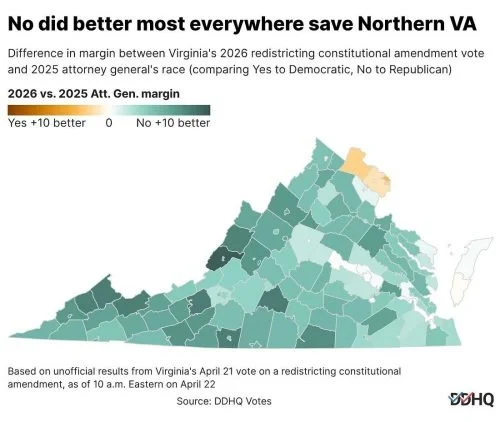
NBC’s Decision Desk HQ has the most telling map:
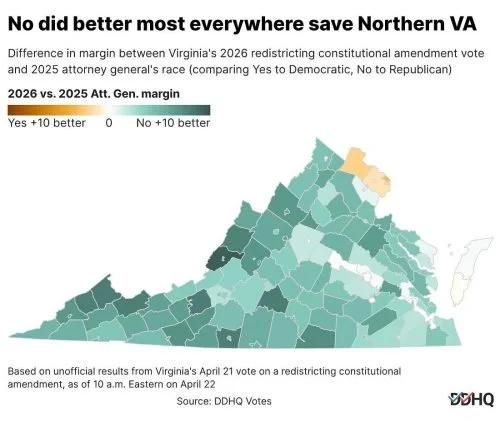
The fact of the matter is that Fairfax County alone dragged the entire Commonwealth to the “yes” column, as was noted by others on Twitter/X:
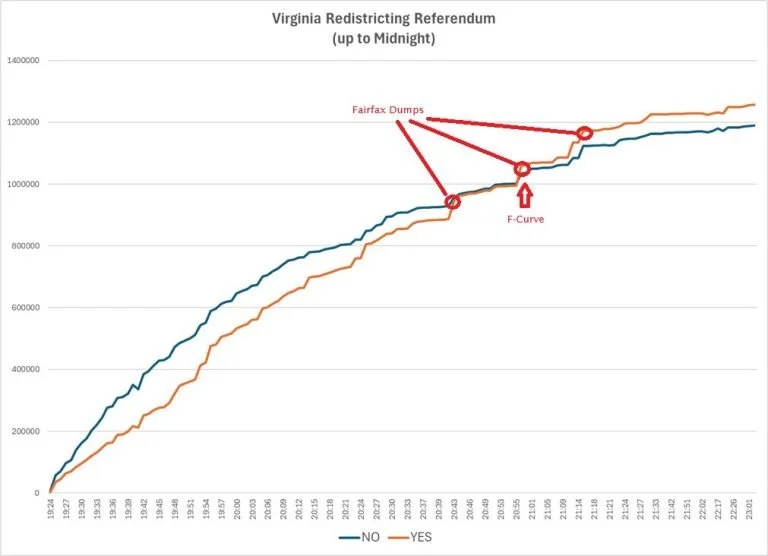
There’s the Lord Fairfax Effect.
Of course, Fairfax County now gets the lion’s share of the Virginia congressional delegation, with five seats being represented by Fairfax, two centered around Richmond, and two more centered around Norfolk. Toss in VA-06 which is huddled around Virginia’s colleges and universities and there you have it.
For all intents and purposes, rural Virginia has been silenced.
Yet it isn’t just rural Virginia that has been silenced in a 51-49 contest, but rather that Virginia Democrats chose to silence the voices of half of their friends and neighbors. Half.
Someone will have to explain to me why the U.S. House of Representatives — a body created to represent the will of the people — must have the totalizing representation that the U.S. Senate by design already has. The mockery of online progressives who argue that statewide votes aren’t 51-49 but 100-0 outcomes intentionally miss the point. There is a reason why the Founding Fathers wanted representation in the House of Representatives.
What burns most observers isn’t merely the fact that $80 million dollars was spent to disenfranchise half of Virginians. Nor is it the fact that Spanberger’s centrist mythology was sacrificed on the same funeral pyre. Nor is it the fact Virginia Democrats are still at sixes-and-sevens (stop — don’t do the hand gesture) over the state budget while localities have to twist in the wind. Nor is it the fact that these 10-1 seats might very well end up being 7-4 if the opprobrium of gerrymandering sticks to the Democrats trying to choose their constituents rather than constituents selecting their representatives.
What is grating most observers is that half of our neighbors and friends chose to disenfranchise the other half under the pretense of fairness.
Now Virginia Democrats will point towards other states and argue whether those lines are indeed fair. As of this moment, Virginia is now the worst state in the Union when it comes to redistricting:
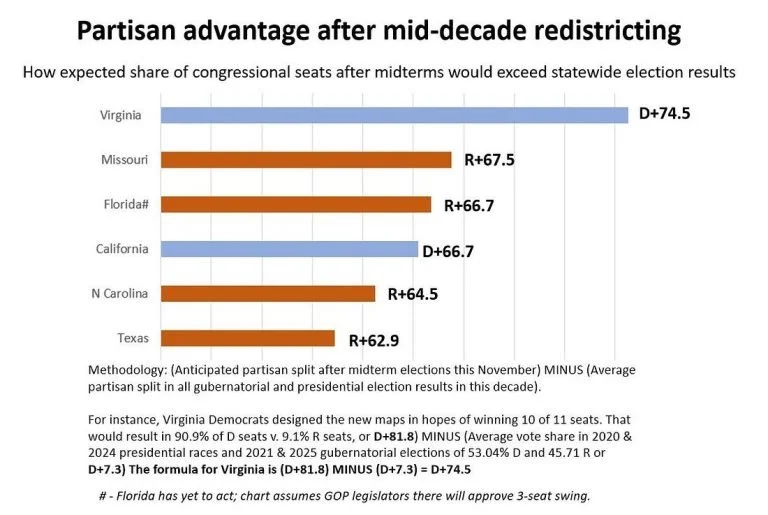
Yet the whataboutism in other states is a fig leaf indeed. If we lived in Missouri or Texas or North Carolina or California — we might have a point, but we live in Virginia where we enjoyed a model redistricting process that was fair, unbiased, and represented the totality of the Commonwealth.
This fairness was overthrown by $80 million of outside money, crafted in language that was patently unfair, which disproportionately produced a 91-9 displacement in a state which very nearly rejected the amendment against all odds in a 51-49 vote.
Should the Virginia Supreme Court find grounds to overturn the gerrymandering amendment, there are ample grounds to do so. For an amendment to cloak itself in “restoring fairness” while producing a patently unfair result screams of disenfranchisement. Yet one finds it nearly impossible and most likely improbable for SCOVA to overturn the public will in a referendum — not to mention that the judges appointed to SCOVA must return to a Democratic-controlled General Assembly for reappointment.
So, where does that lead us?
The good news at present is that the myth that Virginia is a blue state has been shattered into a million pieces. The pyrrhic victory has cost Virginia Democrats nearly all of their political capital, including Governor Abigail Spanberger — whose public persona of centrist is no longer trusted by anyone.
Of the 14 localities that voted for Spanberger and flipped to the “no” column, many of them were suburban localities on the fringes of the Northern Virginia metropolis — notably the Fredericksburg area where Stafford, Spotsylvania, and Caroline all voted against gerrymandering.
The real risk for Virginia Democrats right now is the Virginia Senate. Which if Virginia Republicans can defend the seats we hold — State Senator Tara Durant (R-Stafford) being the premier race against what will presumably be a second run by Democrat Joel Griffin of Fredericksburg — the opportunity for two pickups is definitely in play. Recovering many of the House of Delegates seats lost is also now on the table, though whether or not House Republicans can recapture a majority is a distant — but not impossible — reality.
The problem for Virginia Democrats is that no one will believe or actually believes the centrist rhetoric anymore. When in power, Virginia Democrats simply cannot help themselves as fair play and process goes out the window and partisan power grabs become the norm. The state budget debacle is just the surface of a massive iceberg, the volte face on taxing data centers has long ramifications for the sole fact that it is even being considered, as it jeopardizes every MOU signed by the Commonwealth on this and many other investments ranging into the billions of dollars.
The real question is whether or not Virginia Republicans will capitalize on this by returning to the party of ideas — or whether we will fight fire with fire and take our eyes off the ball, treating victory as an endorsement rather than as a pleading from the voters to stop doing crazy.
In the meantime, Virginia Democrats have all of the levers of power and can do just about everything they want. Unlike the Republicans in Washington who also enjoy both chambers and the executive, there is no filibuster to slow them down other than a robust and watchful fourth estate.
Yet if there is a solid warning in all of this, it is a reminder that should Democrats ever regain total control in Washington, they will most certainly suspend fair play and good process to get what they want. Democrats will end the filibuster, pass everything, and pack the courts to protect their gains. Look at the damage Northam did in the two years he enjoyed total power and have no illusions as to what the next two years will bring — and four years if Virginia Republicans do not recapture at least one chamber of the General Assembly.
The message has been sent and delivered in Richmond. Whether rural voters can recapture a House seat or two in Washington depends on whether grassroots voices are willing to work for it — as they surely did over the last four months.
Yet our statewide seats — U.S. Senate, Governor, Lieutenant Governor, and Attorney General — are all now most certainly achievable given the hard work former Attorney General Jason Miyares and others put into opposing the gerrymandering amendment.
For Virginia Republicans, our first task will be 2026 in seats such as VA-02, VA-06, and VA-07 — Jen Kiggans, TBD, and Doug Ollivant being the frontrunners in each — where new district chairs will be charged with the task of bringing in new leadership to help unit chairs get their precincts staffed up with volunteers.
Yet there it is. No one is coming to the rescue of the conservative movement in Virginia. Certainly, it wasn’t the White House whose focus by nature is more broadly oriented around protecting the U.S. Senate. Certainly, it wasn’t national money, who bought the media narrative that Virginia was a blue state forever. Certainly, it will not be the consultant class.
Virginia conservatives are realizing our own strength
If there is one lesson to be drawn from all of this, it is that our friends and neighbors who saw the problem and worked assiduously to stem the tide very nearly did it — without help, without aid, without resources. Now we know where we stand, and much like the early Virginians such as Patrick Henry and Thomas Jefferson, we are going to have to do it ourselves.
Yet here’s the thing — I’m not reading too much discouragement among Republicans right now. Several messages were sent. Virginia is not a blue state by a mile. Virginia Democrats misled the public to win. The veneer of centrism among Virginia Democrats is gone, gone, gone. Virginia Republicans didn’t do it alone — a good number of shocked Democrats who truly are centrists linked arms with independents and commonsense Republicans to send a message.
That counts in more than just moral victories. That’s going to count in November, if for no other reason than Virginia will be the martyr other Republicans will point towards should Democrats gain power — and we can take it back, provided we do it on ideas and not meet the Democrats on their own turf.
The Rich Men North of Richmond who astroturfed the gerrymandering? If moral outrage is still the most powerful motivating force in politics, then that capital is squarely on the side of Virginia Republicans today — let’s not squander it and get to building the future. Quickly.
Shaun Kenney is editor for The Republican Standard. This column has been republished with permission from The Republican Standard and Bacon’s Rebellion.