
BREAKING: Lawsuit Challenges Virginia’s Abortion Amendment as Deceptive
by Victoria Manning
Physicians are suing to block a ballot question they say conceals the true scope of the legislation.
A group of physicians and other medical professionals along with a local voter have filed a lawsuit challenging an abortion related constitutional amendment on Virginia’s ballot this November. The complaint alleges that the ballot question adopted by the General Assembly fails to inform voters about significant and potentially harmful provisions in the adopted legislation.
The amendment would overturn significant aspects of Virginia regulatory authority, including overturning parental consent requirements and abortion safety standards.
The Founding Freedoms Law Center (FFLC) filed the suit on behalf of the plaintiffs, the Association of American Physicians and Surgeons, the Virginia Medical Freedom Alliance, and Meagan Kade, against the Virginia Department of Elections and others. The complaint alleges the ballot language fails to notify the voters of key aspects of the legislation.
The actual ballot question says:
Should the Constitution of Virginia be amended to (i) protect the freedom to make personal decisions about prenatal care, childbirth, postpartum care, birth control, abortion, miscarriage management, and fertility care; (ii) protect doctors, nurses, and patients from being punished for these decisions; and (iii) allow for restrictions on access to abortion during the third trimester of pregnancy except when the patient’s health is at risk or the pregnancy cannot survive?
The legal challenge alleges the ballot language “profoundly misleads by omission and misrepresentation.”
Another allegation in the lawsuit concerns Virginia Code 30-13, which requires the Clerk of the House of Delegates to present copies of the proposed amendment to the clerks of Virginia’s circuit courts to publicize so voters are aware. This was required to be done 3 months prior to the November 2025 general election. It didn’t happen.
The plaintiffs ask the court to declare and direct the amendment question invalid. Specifically, because the ballot language violates the Virginia Constitution and the proposed amendment did not get distributed and posted as required.
What’s Actually in the Legislation
The legal complaint outlines issues in the actual constitutional amendment that the ballot question omits:
Terminating Virginia’s statutory requirement for parental consent prior to a minor obtaining an abortion, and likewise removing notification requirements;
Ending Virginia’s ability to limit the performance of sexual sterilization procedures on consenting minors, removing potential parental consent or notice requirements;
Allowing any person—licensed or not—to perform abortions (currently, only licensed medical professionals can do so), by prohibiting the Commonwealth from penalizing any person who does;
Ending or severely limiting Virginia’s ability to set safety standards for the performance of abortions;
Ending Virginia’s criminal prohibition against adults engaging in consensual sex with minors of reproductive age (i.e., statutory rape laws);
Terminating Virginia’s ability to restrict sexual conjugal visits for prisoners; and
Ending or severely limiting Virginia’s ability to regulate the assisted reproductive technology industry, including the performance of in vitro fertilization, commercial surrogacy, human genetic engineering (e.g., the creation of “designer babies”), reproductive child cloning, etc.
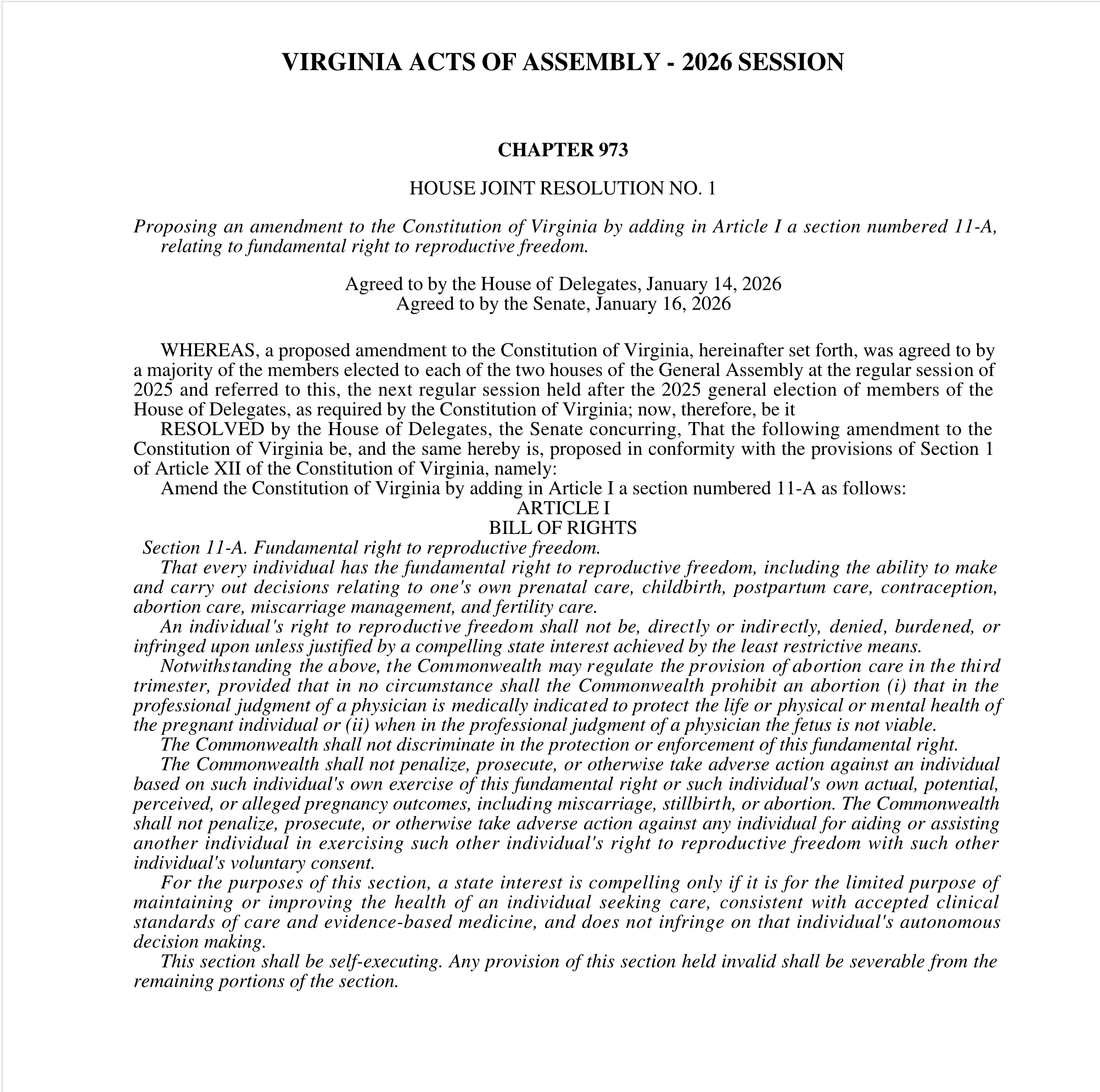
A voter reading the ballot question would not know about any of these serious issues.
The question also implies there will be greater restrictions on third-trimester abortions. The opposite is true. The amendment would remove current restrictions on late-term abortions, such as requiring three doctors to sign off, or only allowing a third-trimester abortion due to a substantial risk to the mother’s life or health. It would, in fact, allow a third-trimester abortion for virtually any reason, with only the abortionist having to sign off on it.
Democrats love to use deceptive language—nothing new here. Their recent redistricting ballot question put before Virginia voters in April demonstrates that tactic. The deliberately confusing wording left voters uncertain about what they were voting on.
Are Democrats concerned the merits of the legislation won’t pass the scrutiny of voters?
Democrats Define Contraception to Include Sterilization
While the proposed constitutional amendment doesn’t define contraception, another law just adopted by Democrats does offer a definition. House Bill 6, signed into law by Gov. Spanberger (D-VA) dictates a “right to contraception” — defined as “the use of contraceptives or sterilization procedures.”
Restoration News previously reported concerns with HB 6, pointing out that it would establish a right to obtain contraceptives and sterilization with no age limit or parental consent required. The proposed constitutional amendment provides “a right to reproductive freedom” including contraception.
Virginia has a dark history of forced sterilizations of people with disabilities. In 1924 Virginia Democrat Governor E. Lee Trinkle signed into law the “Eugenical Sterilization Act.” The legislation allowed a state institution to sterilize a patient if it was determined the patient’s mentally deficient traits were hereditary. Among those the state could sterilize: someone deemed feebleminded or epileptic. From 1924 to 1979 nearly 8,000 Virginians in state hospitals were sterilized.
Untold Harm to Virginia with No Consequence
If the new constitutional amendment is adopted, it could harm vulnerable Virginians. The amendment prohibits prosecutions against anyone aiding or assisting someone exercising their “right to reproductive freedom.” While the legislative language indicates the patient would be required to give consent, there are vulnerable Virginians who may not have the capacity to consent. Could a doctor sterilize a mentally ill patient not competent to make their own decisions without any negative consequences?
While the legal complaint does not address the issue of sterilization of those deemed mentally ill, the filing does share concerns about the sterilization of minors without parental consent.
The legislation raises fundamental concerns about parental rights, medical standards, and the protection of vulnerable citizens. The lawsuit filed by FFLC argues that voters deserve full transparency before casting their vote on a life-altering constitutional amendment.
Republished with permission from Restoration News.