Do Democrats Really Believe in a Constitutional Republic?
The meltdown over the Virginia Supreme Court striking down Democrats’ illegal gerrymandering shows how far they’ve fallen from America’s constitutional foundations.
by Jacon Grandstaff
The childish meltdown Democrats have had in reaction to the Virginia Supreme Court’s striking down their unconstitutional gerrymandering shows they don’t know much about our republican form of government or simply don’t support it.
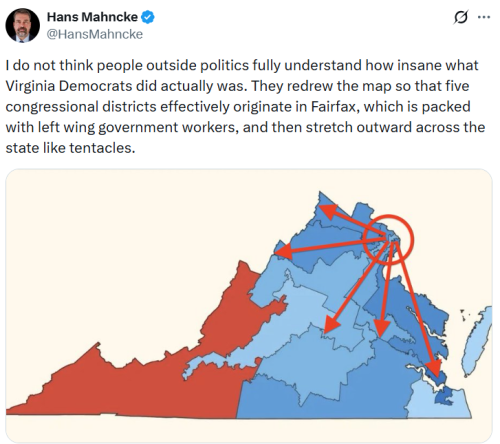
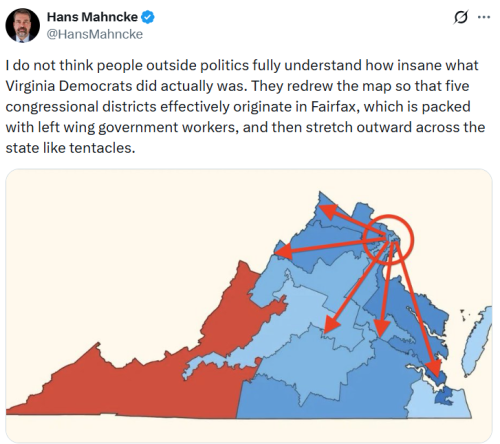
Virginia Democrats tried to flip Virginia’s congressional map from a 6–5 Democratic advantage to an egregious 10–1 split before the 2026 midterms.
On May 8, the State Supreme Court ruled that the General Assembly violated the constitutional procedure to submit the proposal to voters.
Virginia’s Constitution requires any proposed amendment to pass the General Assembly in two consecutive legislative sessions with an intervening general election. If voters don’t like the proposal, they can kick enough legislators out so that there are insufficient votes to pass it a second time.
Virginia Democrats ran roughshod over that requirement. The Democrat-controlled General Assembly passed the redistricting proposal last October—mere days before the fall elections and after early voting had started. This violated the constitution to amend the constitution, as Virginia House Minority Leader Terry Kilgore (R) rightly noted. They then passed it a second time in January and rushed it to a special election referendum in April.
On April 22, a Tazwell County judge agreed with Kilgore and other Republican plaintiffs that the General Assembly had failed to follow the required procedures.
The Virginia Supreme Court affirmed the lower court ruling. Justice Denham Arthur Kelsey wrote in the majority opinion: “The purpose of Article XII, Section 1 is to give voters the opportunity to participate in the process of amending their constitution. The commonwealth in this case . . . ended up denying over 1.3 million Virginians their constitutional right to have a voice in the debate over whether their constitution should be amended.”
Predictably, Democrats erupted in fury.
Demanding mobocracy over the rule of law
Virginia Attorney General Jay Jones (D) accused the court of putting “politics over the rule of law,” claiming the decision “silences the voices of the millions of Virginians who cast their ballots in every corner of the commonwealth.”
But the rule of law in Virginia stipulates that a popular vote of the people is not enough to amend the constitution.
House Minority Leader Hakeem Jeffries (D) declared the ruling “an unprecedented and undemocratic action that cannot stand.”
The worst argument Democrats have brought is whataboutism regarding redistricting in Republican-led states. For instance, they claim it’s not fair that Florida and Tennessee redistricted—and, unlike Virginia, their citizens didn’t get to vote on it. But each state has unique laws governing redistricting. The fact they don’t understand federalism—or pretend not to—indicts Democrats’ ability to properly govern in a constitutional republic.
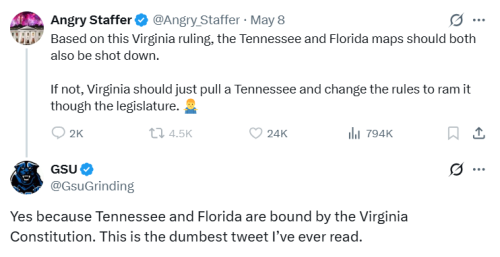
It would be one thing if it was only leftist keyboard warriors making these arguments. But many high-ranking Democrats joined the demagoguery.
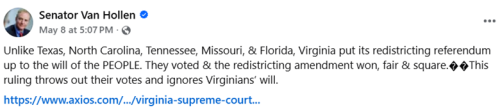
Even if Florida and Tennessee had the same redistricting rules as Virginia, they don’t have to amend their constitutions to redistrict. Virginian voters had previously passed an amendment setting up a bipartisan redistricting commission—which incidentally passed by a much larger margin than this amendment, which barely passed 52–48.
Democrats have made it clear they do not want 50 laboratories of democracy, but a centralized, majoritarian blob, lurching in whatever direction the passions of the moment compel it.
This is what the founders feared
Our country’s Founders wisely made it much harder to change the U.S. Constitution than to pass legislation through Congress. After Congress submits proposed amendments, those amendments require three-fourths of the states instead of a simple majority, ensuring any monumental change comes through deliberation and overwhelming popular support.
They understood that allowing outright democracy was the surest way to destroy the country they had just created.
Virginian James Madison warned in Federalist 10 of the “instability, injustice, and confusion” introduced into the public councils by the “violence of faction,” adding that pure democracies have “ever been spectacles of turbulence and contention.”
John Adams put it more bluntly: “There never was a democracy yet that did not commit suicide.”
Virginia’s mandatory waiting period between legislative sessions for constitutional amendments is a deliberate cooling mechanism, designed to force elected officials and the public to consider proposed changes to let temporary passions subside before altering the document that governs them.
In an era when social media can whip millions into a frenzy over a ruling they haven’t read—based on takes from streamers who know nothing about civics—this is more necessary than it was during the Founders’ era.
The General Assembly knowingly skipped this cooling period, hoping the courts would yield before the slim margin of consent their donors manufactured by dumping over $100 million of untraceable dark money into the campaign. When the court followed the constitution instead of the astroturfed “will of the people” at that moment Democrats cried tyranny.
Democrats radical proposed next steps
Liberal commentator and blogger Matthew Yglesias wrote to his 660,000 followers on X, “Don’t know what the mechanisms are but these Virginia judges need to go.”
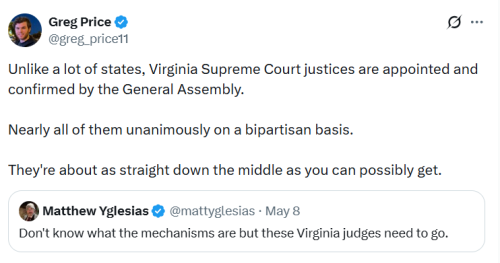
He of all people should know how to google those mechanisms and educate his Virginian followers on how they can lobby their representatives.
But rage-bating and hoping for revolution has always been easier…and more profitable…for online influencers than real democratic activism.
Communist streamer Hasan Piker—who actively campaigns with Democratic congressional candidates—went further still, posting, “Those who make peaceful revolution impossible, make violent revolution inevitable.”
The New York Times reported that on a call between Virginia’s congressional Democrats and Jeffries, some Democrats did propose concrete solutions. However, none of them are likely to go anywhere in time for the midterms.
Some suggested lowering the retirement age for state Supreme Court Justices from 73 to 54 and replacing them with “sympathetic Democratic lawyers.” Another proposal included seeking to invalidate the 2020 constitutional amendment that created the redistricting commission because the notices at courthouses weren’t properly posted.
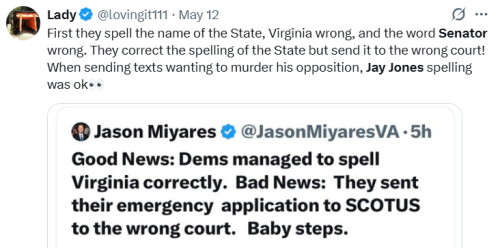
Attorney General Jones quickly filed an appeal with the U.S. Supreme Court but his sloppiness likely didn’t help his case.
Democrats’ reaction to this ruling should be a warning to every American who still believes in the country’s constitutional republic. A party that willfully ignores constitutional norms to rule by plebiscite cannot be trusted with the reins of power. When members of that party and the activists who wield immense influence over it demand it trample the courts to pass what they want, it becomes a danger to the principles Americans believed in, fought and died for 250 years ago. Virginia’s Constitution was written to protect itself from the temporary passions of mobocracy. For now, by a slim majority, Virginia’s Supreme Court is holding the line.
Jacob Grandstaff is an Investigative Researcher for Restoration News specializing in election integrity and labor policy. This article has been republished with permission from Restoration News.