A Lesson from Amsterdam
A transportation infrastructure built around the primacy of bicycles works OK for the Dutch, but Virginians would never accept it.
by James A. Bacon
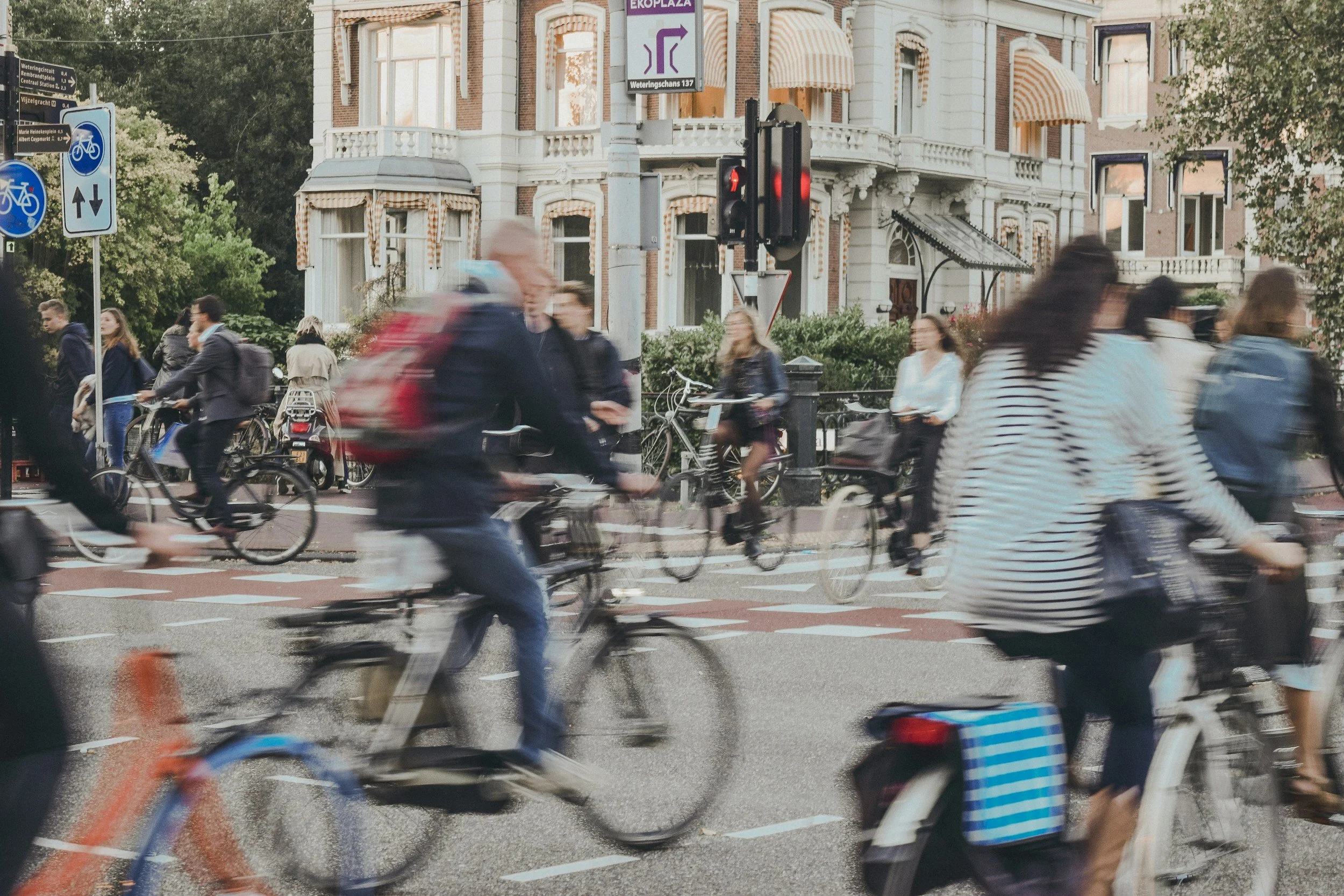
Amsterdammers love their bicycles. They ride their two-wheelers in the sun, in the drizzle and in the rain. They bedeck them in flowers and deck them out with baskets. Like the Inuit who have words to distinguish between different types of snow, the Dutch have an elaborate vocabulary to describe bicycle accessories, such as kinderzitje (child seats), fietskar (bike trailers), and bakfiets (large boxes mounted in front of the rider that carry groceries, children, or anything else that fits).
According to CoPilot AI, there are about 800,000 bicycles in Amsterdam, a city of roughly one million inhabitants, compared to maybe 400,000 automobiles. The city is a dream come true for smart growthers. In the city’s historic district, bicycles exceed cars in the streets at any given time by prodigious numbers, and both are outnumbered by the swarm of pedestrians.
A pedestrian/bicycle-centric society is a desideratum of the green, zero-carbon future. Amsterdam, Copenhagen and some smaller European cities are held up as models to be emulated in the United States. Whether Amsterdam’s bike-centric model could be replicated in Virginia, however, is doubtful. Whether anyone in an American city would even want such a transportation system is questionable.
A bicycle-centric transportation network is not traffic nirvana. CoPilot notes that there were more than 5,000 traffic accidents in Amsterdam in 2022, about half of which involved bicycles. I know about that from personal experience. (More on that in a bit).
Then there’s a factor that no one ever talks about: bicycles trash up the landscape. Those 800,000 bicycles have to be stored somewhere. Usually outdoors. The city has endless, long racks of them. And they are ugly…. as in uuuuugly. Amsterdam would be a much more beautiful city without them.
Don’t get me wrong. Amsterdam is a marvelous city, blessed by a rich history, memorable architecture, and scenic canals. Indeed, it is more than marvelous — it is an engineering marvel built on swamp, some of it under sea level. The city relies upon pumps to keep out the ever-intrusive water. Dutch ingenuity has cobbled together an urban fabric in Amsterdam’s city center that provides inhabitants the transportation options of mass transit (buses and electrified street cars are ubiquitous), cars, two-wheelers, pedestrians and canal boats. It is an extraordinary achievement, and I don’t want to belittle it.
However, one must acknowledge that the Dutch have been at this business for a very long time. I remember bicycling through Europe as a teenager more than 50 years ago and gaining a keen appreciation for the network of bicycle paths that allowed our little band to travel off the roads even then. I can’t say how long it has taken Amsterdammers to build their remarkable urban network, but surely they have been working on it for decades, if not centuries. Bike lanes are integrated into almost every street and alleyway. Outside of a few limited-access motorways, no street or road is off limits. The expense and disruption to retrofit Virginia cities similarly would be incalculable.
Bicyclists rule in Amsterdam’s city center, a district that contains between 80,000 and 90,000 inhabitants (and many thousands of tourists). There are plenty of cars — you see them parked in every available spot — but they creep along like snails, yielding the right-of-way to pedestrians and bikes. Bicycles (and other two-wheelers like motorcycles and electric bikes) dominate. Cars and pedestrians alike yield to them. Visitors quickly become acclimated to the briiing-briiing sound of the bicycle bells from hell. Bicyclists don’t slow down. They ring their bells and plow through a crowd, expecting the footbound to jump out of the way.
To say that bicyclists feel entitled is an understatement.
(It’s only fair to note that pedestrians feel somewhat entitled as well. Sidewalks have little meaning to them. They drift between sidewalks, bike lanes and traffic lanes at will. But Amsterdammers have developed a sixth sense that keeps them out of the way of bicycles — most of the time.)
I learned the hard way last week while on vacation as I made my way from the Tulip Museum to the Ann Frank House. There was a four-way intersection, jammed with Amsterdammers and tourists. I was attentive to the bikes, but not attentive enough. A young man came flying over the canal bridge and clipped me, knocking me over. I stumbled, broke my fall with my hands, and did a back roll, so no body parts were damaged. A passerby lent me a hand to help me to my feet. The young man who clipped me stopped to ask if I was OK. I said I was. He (or someone — everything happened so fast it’s a bit blurry) asked if I’d hit my head. I said no. Then seeing his bike on the ground, I asked if he was OK. He said he was. And off he went.
I’m confident that my incident was never reported, which means it never made it into the city statistics. Official accident statistics are probably understated. I talked to two different Uber drivers who had personally witnessed numerous bicycle accidents and had tales of their own encounters with crazed cyclists. Uber drivers in Amsterdam are not bicycle fans.
Speed limits apply only to automobiles. In theory, they apply to bicyclists, too, but the Uber drivers complained that the limits are never enforced. Bicycles fly along the urban streets faster than anyone else, and that includes cars. The problem has gotten worse in recent years, apparently, as more people drive electric bikes. And innovation being what it is, people are inventing new types of bicycles. A recent novelty is heavy bikes with fat tires — the Humvee version of bikes — which are all the more intimidating to people on foot.
At the end of the day, bicycles are less likely to lead to fatal accidents than cars. But let no one pretend that they are entirely safe.
Now, let’s balance the marginal gains to safety against other considerations, starting with aesthetics. While a few bicycles resemble the flower-decorated vehicle atop this page, most are beaters. Amsterdammers apparently don’t have room in their small dwellings to store the bikes, so they park them outside. You can see them everywhere, on every street and in every alleyway, chained to bike racks, canal rails, street signs, and anything else stationary.
The photo below is not atypical. Bicycle clutter is omnipresent. Admittedlly, one can store far more bikes than cars in the same square footage, which does eliminate a different kind of eyesore seen so often in America — vast parking lots — but let’s not pretend there’s anything visually appealing about it.
There is one other consideration, and I gained little tangible information about it during my two-day stay in the city, but it seems relevant to any discussion: comfort and convenience.
Hardy Amsterdammers don’t let a little rain deter them. It rains a lot in the Netherlands — Amsterdam sees about 120 rainy days a year. The Dutch just bundle up and deal with it. I’m not so sure how sanguine Virginians would be about peddling to work in inclement weather.
Perhaps more relevant to any discussion of transplanting Dutch ways to Virginia cities is the matter of convenience. I think about all the stuff — groceries, retail purchases, junk to the landfill — that I lug around in my car. I can’t imagine doing that on a bicycle. I don’t know how the Dutch, even with their fietskar and bakfiets, manage it. Any change would be all the more traumatic for Virginians given the longer distances (and time spent peddling) in our sprawling, low-density metropolitan areas. Amsterdam’s population per square mile is almost three times that of, say, Richmond. That means far more destinations are within cycling distance there than here.
The Amsterdam experience makes it clear that different human settlement patterns from those to which Virginians are accustomed can be made to work. Some Dutch may grumble about the downside but they appear devoted to their way of life. I just don’t see how that way of life can be replicated in Virginia, and I can’t imagine that any but a tiny minority of Virginians would have any desire to replicate it.
State and local governments in Virginia still are devoting millions of dollars on creating more bike-friendly streets and byways, but here in Richmond I don’t see more cyclists on the roads. Until we densify our cities to Amsterdam levels and make massive streetscape investments to do so, I don’t see that changing.
Republished with permission from Bacon’s Rebellion.