AI Roasts Virginia Beach
Scrolling through X the other day I stumbled on an amusing post by someone who asked AI to “roast” Virginia Beach. The result was spot on.
Impossibly accurate.
So I decided to give it a try.
I asked ChatGPT to produce a “roast” of Virginia Beach. The prompts I gave only mentioned that all of the ocean views are obscured by hotels, that the sun sets at 3 p.m. on the resort strip beach as it slips behind the buildings and that the beachy atmosphere is a little dicey after dark.
In under one minute, this is what our friendly bot created:
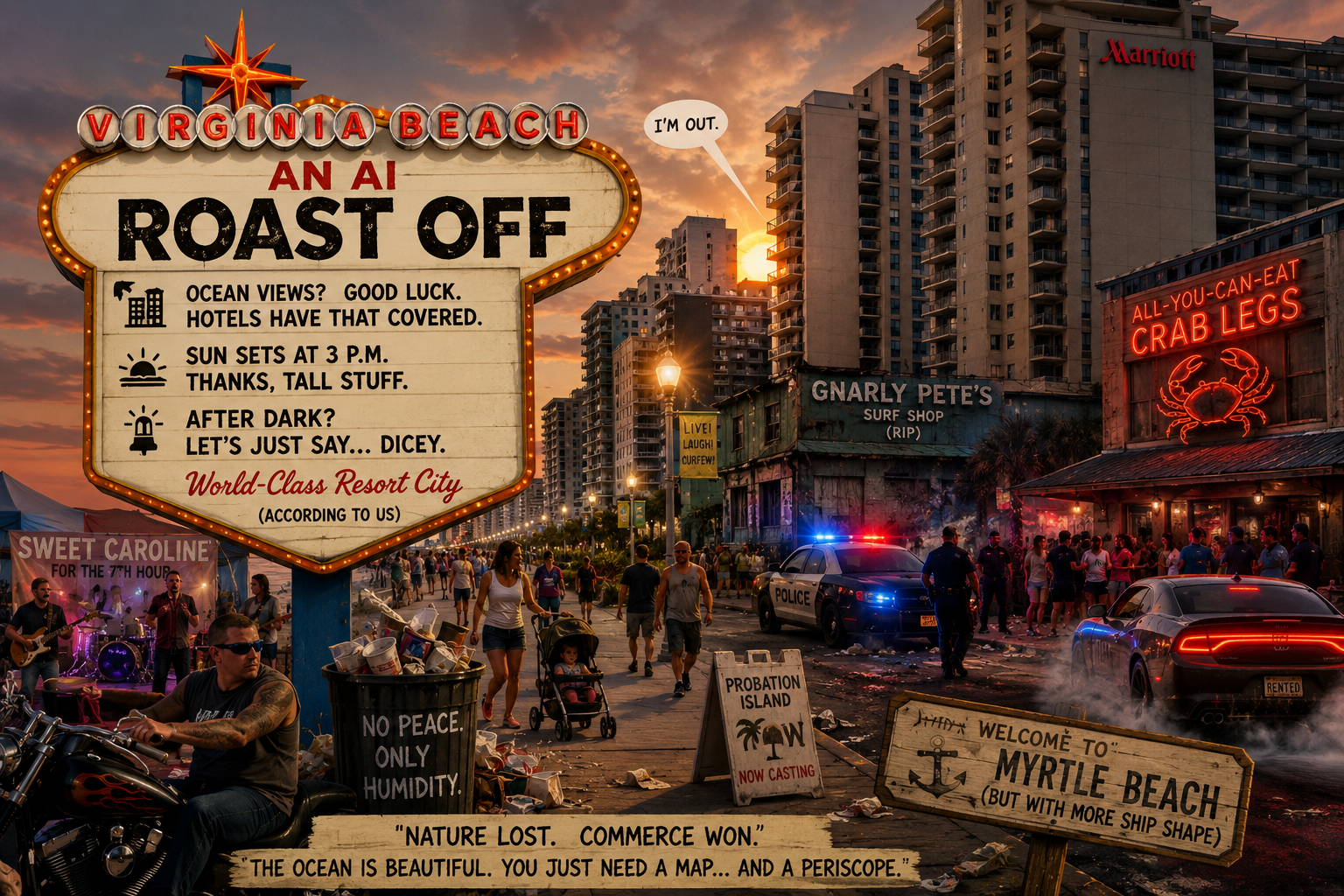
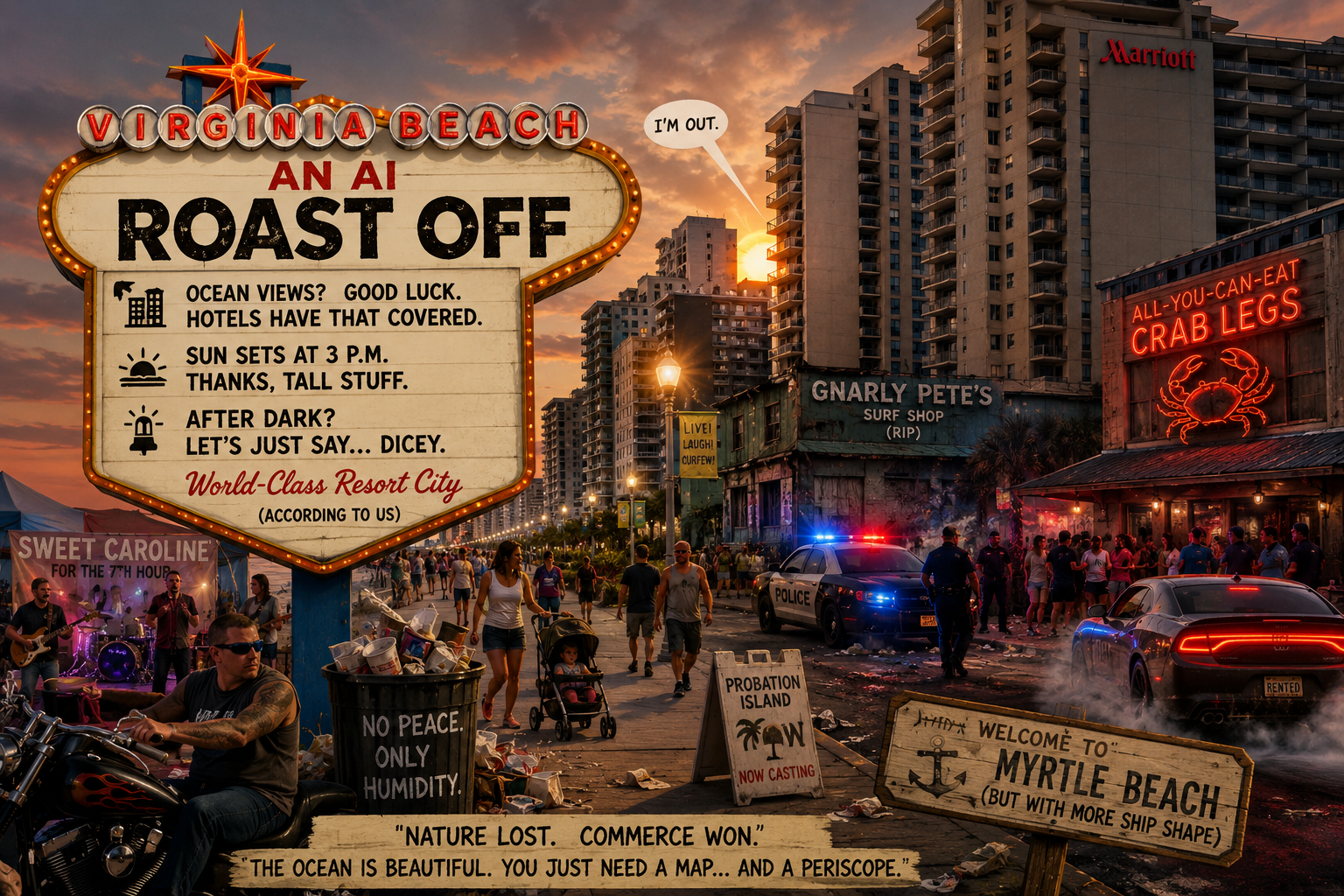
Virginia Beach is what happens when a city looks at a gorgeous stretch of Atlantic coastline and says, “You know what this needs? More timeshare architecture.” Somewhere along the way, local planners decided the best use of priceless oceanfront property was to line it with towering concrete hotel blocks that resemble a mid-budget casino district fleeing inland from Atlantic City. The result is a beach where the ocean is technically visible, provided you are standing at a precise 14-degree angle between a Marriott parking garage and a frozen daiquiri stand.
The city’s zoning philosophy appears to have been developed by a committee whose only guiding principle was: “What if absolutely everything cast a shadow?” By mid-afternoon, the resort strip darkens like an eclipse simulation at a science museum. The sun doesn’t so much set in Virginia Beach as file a noise complaint and leave early. Families arrive expecting golden coastal sunsets and instead spend half their vacation wrapped in damp towels beneath the looming silhouette of twelve stories of discounted balcony suites and an abandoned surf shop called something like “Gnarly Pete’s.”
And then there’s the nightlife — or more accurately, the survival challenge. Virginia Beach officials spend years marketing the oceanfront as a carefree tourist paradise, only for visitors to discover that after dark the resort area can feel like a social experiment testing the limits of municipal denial. Every summer weekend brings the familiar local tradition of hearing police sirens blend harmoniously with bass rattling from rented Dodge Chargers. The city’s solution is always some variation of adding another curfew, another “enhanced police presence,” and another press conference assuring everyone that this latest shooting was “an isolated incident,” despite the fact that there are now enough isolated incidents to form their own neighborhood.
The boardwalk itself has the energy of a place permanently trapped between spring break and a misdemeanor hearing. Half the people are pushing strollers, the other half appear to be auditioning for a reality show called Probation Island. Somewhere nearby, a man in wraparound Oakleys is revving a motorcycle while a cover band massacres “Sweet Caroline” for the seventh consecutive hour. The air smells like sunscreen, vape clouds, stale beer, and poor decisions. There is no peace. There is only humidity.
And yet Virginia Beach remains deeply committed to insisting it is a “world-class resort city,” despite all evidence suggesting it is really just Myrtle Beach with a larger military presence and slightly better municipal branding. It’s a place where nature and commerce entered into a bitter custody battle and commerce won full custody, visitation rights, and naming sponsorships. The ocean is still beautiful, of course — you just have to locate it behind seventeen floors of stucco and a neon sign advertising all-you-can-eat crab legs.
Scary isn’t it?
My work here is done.