Lies, Damned Lies, and VPAP: The Myth of Nonpartisan Institutions
There's a reason why nonpartisan anything is the most partisan voice of all, because it always defends a status quo.
by Shaun Kenney
“If everybody always lies to you, the consequence is not that you believe the lies, but rather that nobody believes anything any longer.”
I’ll start with WTKR 6 in Richmond.
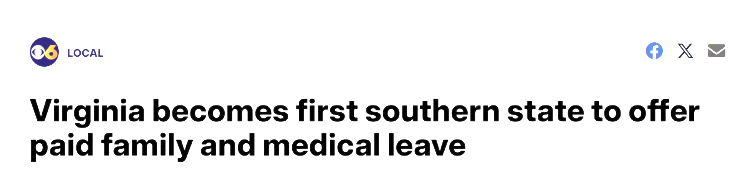
Just last week, Governor Abigail Spanberger (D-VA) signed a bill that would mandate that businesses provide 12-week paid family medical and parental leave to each and every Virginian beginning in 2028.
Here’s the headline:
I’ll be honest — this is a good bill which focuses on families. This isn’t socialism; this is insurance. For myself, as a committed pro-life Catholic, we do a lot of talking about babies and it is high time we took just as much time talking up and taking care of mothers and families.
Now contrast this headline with one from last year when Governor Glenn Youngkin (R-VA) announced several signatures promoting small business development:
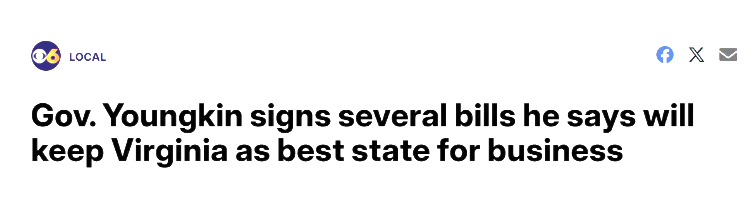
Notice the difference between the two? On the former, the headline is rather positive precisely because it is a good bill. No questioning, no fanfare, no shade.
Yet when a Republican governor signs common sense legislation promoting business growth? It’s not fact, it’s a claim. Youngkin says it will do this. But will it? That’s the implication — it might. Youngkin might be lying. In fact, to as if to confirm the suspicion, then-State Senator Ghazala Hashmi is allowed to get her digs in:
"Paid family sick leave, raising the minimum wage, assuring that there are child care options and protections for so many working families. We didn't hear anything about affordable housing," Hashmi said. "The issues that are facing working families, and the governor never speaks to those concerns."
Never you mind that economic growth is precisely how you pay for all of these things big and small. You can do an awful lot with economic growth, ladies and gentlemen. Nothing that Hashmi mentions offers us even a path towards those things — and nothing suggests that her viewpoint ought to be critiqued in turn.
Yet in the Spanberger piece? Is there even one quote from a critic asking the question how much will this policy cost, what is the impact to businesses large and small, does this policy actually have the effect of helping families?
That right there is where the institutional media bias lies. It is also the reason why alternative media — Substack among them — is so popular on the political right. Because the conservatives are locked out of the institutions, we are forced to build parallel institutions. When we ask for alternative viewpoints to be exposed to the light of day, we are politely but firmly told to go perform an anatomically impossible act.
The Virginia Public Access Project (VPAP) is the epicenter of this hive of nonpartisan activity, deciding what is newsworthy, which opinions should be considered, and which publications are in fact news.
Yet the artful way it presents and selects what is and what is not — editing headlines in their morning roundups, selecting which ones are prominent, excluding others, and presenting facts just-so under the promise of “nonpartisanship” — is indeed the problem. In fact, there is nothing more partisan than nonpartisan anything, precisely because nonpartisanship nearly always defends the status quo.
Thumbs and Scales: The Myth of Nonpartisan Viewpoints
At the heart of this — and by way of example — is a writeup by the former head of VPAP presenting facts just-so regarding the insinuated political tilt of members of the Supreme Court of Virginia:
With no registration by party in Virginia, one of the best indicators of political allegiance is a voter’s history of participating in primary elections.
By that measure, a review of the primary voting history of the justices of the Supreme Court of Virginia suggests that last week’s 4-3 decision fell along partisan lines.
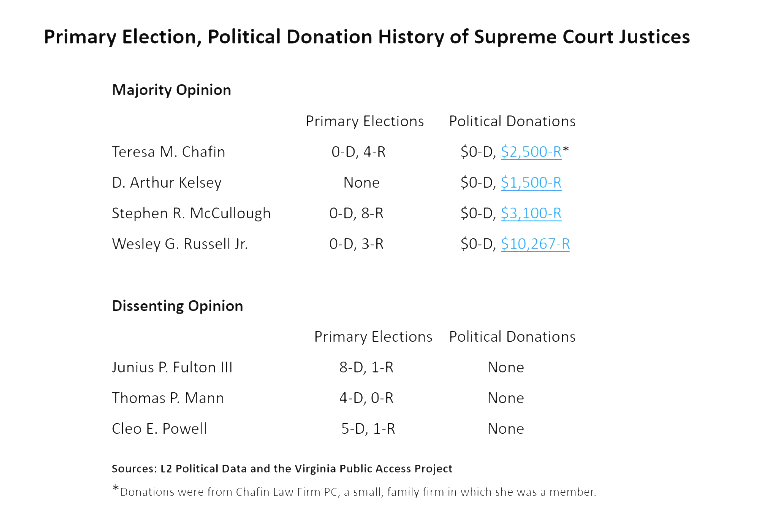
The full write up is here. Of course, there was at least one critical quote — right? Someone presented the other side of the argument for the sake of integrity? Of course they did, because they included the foll—
Holsworth said the redistricting case could forever change the way the public perceives the Supreme Court of Virginia.
“The court’s going to look more like states that elect judges,” he said. “If one party has control, there’s not going to be any doubt where the judges stand.”
The politics of the 4-3 decision should be on full display next winter when the Democrat-controlled General Assembly decides whether or not to reappoint D. Arthur Kelsey, the justice who penned the majority opinion.
Of course, this is the real aim of the missive. Nothing to do with political donations, nothing to do with partisan leanings, but everything to do with finding some reason — any reason — to hang a man in public.
What this article didn’t tell you about Justice Kelsey’s donor history is that it consists of two donations — one made in 1997 and the other in 1998 — made nearly three decades ago and long before he was a justice of the Supreme Court of Virginia.
There’s even this line:
None of the three dissenting justices have been political donors since 1997, according to VPAP.
Which somehow absolves them but doesn’t involve Kelsey as he managed to squeak in that one donation in 1998. What sort of artificial barrier exempts the three dissenting justices from the implication of bias in 1997 that magically applies in 1998?
This right here is the lie of nonpartisan anything, because in their own defense, the argument is that what is presented is merely factual. Is there anything untrue about the form of these claims? Yet if function follows form, the implication here is quite clear, the goal is even formally stated, and the nonpartisan packaging of the information belies a most assuredly partisan point.
This is the spirit of VPAP.
Democracy? Diversity? Viewpoints? Or Is It Just Stomping Out Conservatives?
Part of the problem with VPAP is that their criteria for inclusion is designed to drive out independent media and conservative opinion writers. Sure there are ones-and-twos, but only of the permissible sort of opinion — those who don’t criticize the nonpartisan machine and take the crumbs as offered.
But it is high time we look this problem in the face. When half of Virginia is willing to disenfranchise the other half of Virginia in order to grab 91% of the power, is it too far of a stretch to argue that this same half of Virginia with a disproportionate aggregation of the media might also think of themselves as entitled to a near-monopoly on information and debate?
This, I think, is the problem writ large with our friends on the Democratic side of the aisle — even the well-intentioned ones. That the gerrymandering referendum was even close shocked just about every left-leaning observer. That the reaction to the result was so sharp and divisive shocked just about every left leaning observer. The very idea that half of Virginia deserved 91% of the representation in Washington as being unfair is met with blank stares or a regurgitation of equivocation and dissimilitudes. Never you mind that New England which votes 40% Republican has precisely zero Republican representatives in the U.S. House of Representatives — this is normal. This is nonpartisan. Precisely because it is a monopoly — and it is perfectly normal for Democrats to behave like Democrats and maintain these nonpartisan monopolies that drive Republicans out, provided that Republicans never behave like Democrats and do likewise.
If there was some fraction of my mind that I could drop into the ears of well-intentioned men and women on the center-left, it is that diversity of viewpoints is a positive good for the democratic experiment. That nonpartisan gatekeepers aren’t protecting free speech but rather insisting on managed speech. That this managed approach to ideas not only locks out the good and sincere but allows the bad to virtue signal because it too is locked out. That those who are on the inside lump both the good and bad together precisely because if they were “good” then they wouldn’t be locked out. That true liberalism means an open public square where ideas rise and fall on their merits and not by taking the shortcuts of invoking magic words such as racism! or bigotry! or sexist! or Nazi! or whatever trope of the day serves as a shortcut to thought or a barrier to consideration.
Julia Graef writes an excellent little book entitled The Scout Mindset where she argues that one can either approach new ideas and other people with a “soldier mindset” where every new or different thing is treated with suspicion, where lead is put on the target until it goes away, and the only friends we have are those who are like us. By contrast, the “scout mindset” sees the world in a different way — where new things are interesting, where new ideas are engaging, where new people are opportunities to learn. Does this provide a magic wand to make everyone in the world good? Of course not — but it does allow the space for the things good, beautiful, and true to flourish rather than aggressively hit everything with Roundup.
Until the political left sees the problem in gifting and grifting half of our political life near total control over the institutions — bureaucracy, education, universities, media, entertainment, religion, military and first responders — we aren’t going to fix the fundamental problem that is rocking the pendulum in Virginia or elsewhere.
If Hannah Arendt is any authority on the matter, totalitarianism rarely takes the form of a jackboot or a commissar, and it is why a truly free press matters so deeply to a good and decent public square:
“The moment we no longer have a free press, anything can happen. What makes it possible for a totalitarian or any other dictatorship to rule is that people are not informed; how can you have an opinion if you are not informed? If everybody always lies to you, the consequence is not that you believe the lies, but rather that nobody believes anything any longer. This is because lies, by their very nature, have to be changed, and a lying government has constantly to rewrite its own history. On the receiving end you get not only one lie — a lie which you could go on for the rest of your days — but you get a great number of lies, depending on how the political wind blows. And a people that no longer can believe anything cannot make up its mind. It is deprived not only of its capacity to act but also of its capacity to think and to judge. And with such a people you can then do what you please.”
-- Hannah Arendt, interview with the New York Review of Books (1974)
VPAP branding itself as “nonpartisan” doesn’t make the institution any more or less totalizing when the gatekeepers lie to the public through insinuations and just-so reasoning. They did it then, they do it today, they do it in ways big and small, others learn from this so-called standard, we make it normal, and then we brand it as nonpartisan.
If the standard is totalitarian and the complete eradication of conservative thought, then pity the liberals who will become the new targets of their own left-wing as the ever-increasing drumbeat to drive out dissent acquires new targets. We are already seeing this effect nationally as even U.S. Senator Chuck Schumer (D-NY) — no wallflower of the left — finds himself under increasing pressure to do more, be more, and if not, be replaced by Rep. Alexandria Ocasio-Cortez (D-NY). Surely we have seen this effect as the old liberals in Richmond have been weeded out and replaced by the Portsmouth Way. When the so-called nonpartisan institutions are superseded with the new nonpartisanship — what will the gatekeepers do then? Retire?
Whatever the answer is, one cannot help but think that Virginia’s public square isn’t better served with all of us at the table talking — not just a carefully curated handful which gives the impression that 51% is really 91% of the public discourse. Surely that isn’t good for democracy. Surely that isn’t good for the public square.
The public admission that there is a prejudice in the Fourth Estate against those of us who are not on the left isn’t required — the fact is self-evident. What will be required is the re-establishment of what the Fourth Estate was supposed to be when journalists and columnists were interesting and valued in the public eye.
Like Jacob to Esau, trading the estate for the porridge of clickbait and half-truths isn’t worth the trade. It is damaging to the public and encourages the opinion that nothing is to be believed, which opens the door to a litany of horribles we claim we don’t want, yet feed them every day.
Do better.
SHAUN KENNEY is the senior editor for The Republican Standard. This piece is republished with his permission.