March RGGI Carbon Tax Jumped 26% in One Year
By Steve Haner,
The Regional Greenhouse Gas Initiative (RGGI) held its first carbon allowance auction of 2026 Wednesday and the price came in at just under $25 per ton of emissions, 26% higher than a year ago. There should be no doubt now about predictions that imposing this carbon tax on Virginia electricity plants will cost them $550 million or more per year once Virginia is again a full member.
What the tax costs the electricity producers will then be paid by their customers, one way or another. In returning Virginia to this interstate trading compact the General Assembly imposed no barrier on the utilities or independent producers simply passing the cost on to energy buyers. Raising the price of hydrocarbon-fueled power is the whole point of RGGI.
The price of an allowance has basically doubled since Virginia last participated in this exercise, from 2021 through 2023. If Dominion Energy Virginia goes back to collecting the tax with a direct charge on its monthly bills, what was just over $4 per month three years ago for a 1,000 kilowatt hour user will likely be $7 per month or more in 2027.
The $24.99 auction price was slightly lower than the $26.73 bidders paid in the December 2025 auction. March’s price was held in check by RGGI releasing 7.8 million allowances it had held back in a cost containment reserve (CCR). It did the same a year ago, releasing more than 8 million allowances from the CCR in the March auction, draining its reserve for that year.
The acceleration in the allowance price, really a tax per ton of emissions, is bound to continue. It happens by design. It was $7.60 per ton during Virginia’s first auction just five years ago and was $24.99 per ton Wednesday. If that trend continues (almost 230% growth in five years), in March 2031 the auction price will be approaching $60 per ton of CO2.
While the General Assembly has ordered Virginia back into RGGI with both budget language and legislation, it is not clear whether Virginia will be able to rejoin during 2026. There will be three more auctions this year, in June, September and December.
RGGI runs on a three-year contract process, and this is the final year of this contract cycle, which allotted zero allowances to Virginia. The other states will have to agree to let Virginia in and add to the pool of 2026 allowances before the state can impose the tax again this year.
For the next three-year period, beginning in January, adding Virginia is easier. But the other ten member states have already substantially changed the program for that cycle. Virginia would have to agree to all those amendments and then negotiate just how many allowances would be created and assigned to this state.
The higher the initial number set for 2027, the lower the allowance price determined by the auction will likely be. Just what initial allowance numbers Governor Abigail Spanberger’s team will ask for will matter.
During 2023, the state sold 22.4 million allowances, but it likely won’t be that many for 2027 because RGGI’s overall allowance cap is shrinking drastically. That by design is how it tries to force coal and gas generation facilities to close, by reducing the supply of mandatory allowances.
A summary of the changes to the program, agreed to by the ten long-time members, set an overall ten-state cap of just under 70 million tons of carbon emissions, including the cost containment reserves, down from more than 75 million at the end of this contract cycle. The price that triggers the use of the cost containment reserves will also grow rapidly.
The new agreement lowers the allowance amounts for the states by about 10 percent per year. You can see the impact on the chart reproduced below, and the dramatic change from the current allowance targets. The Spanberger Administration is probably going to be fine with imposing that reduction rate on Virginia’s allowances, too, but the outcome is likely to be a far higher price paid by electricity generators in the late 2020s.
Several major states within the PJM Interconnection regional electricity pool are not part of RGGI. With the reimposition of the RGGI tax on Virginia power plants, Virginia plants will produce and sell less electricity, and the deficit will be made up by rising imports from those non-RGGI states, such as Pennsylvania, Ohio and West Virginia. That is what happened from 2021 through 2023. RGGI supporters ignore that the emissions did not go away but simply moved to another state.
Because of that, and the math gets very complex, the carbon tax is only part of how RGGI forces up costs for Virginia consumers. The less efficient operation of Dominion’s and the other Virginia plants also has economic consequences. It would take a long discussion to explain, perhaps for another day.
RGGI doesn’t lower emissions at all, not one ton. It only enriches state treasuries and non-RGGI state generators at the expense of Virginia energy consumers.
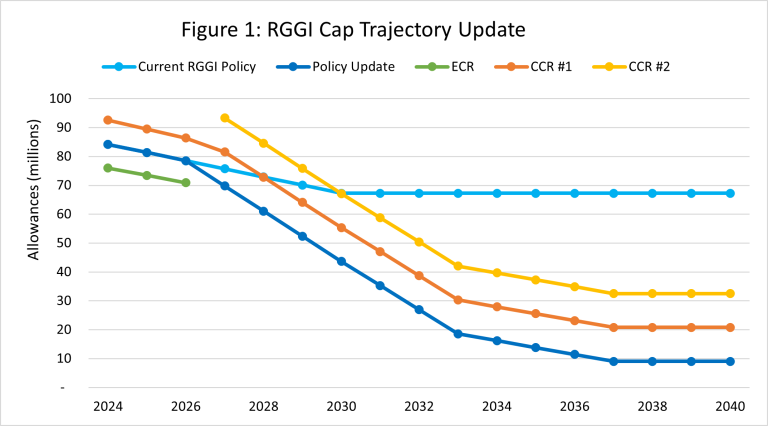
RGGI’s new restrictions on the number of CO2 carbon tax allowances (dark blue line), dramatically lower than the current system (light blue line), even with major cost containment reserves. Less supply is likely for force the price (tax) to keep rising. Source: RGGI
Republished with permission from Bacon’s Rebellion.