Scrapping the Work of the Founding Fathers
Dems are crafting a revolution with an end-run around the Constitution.
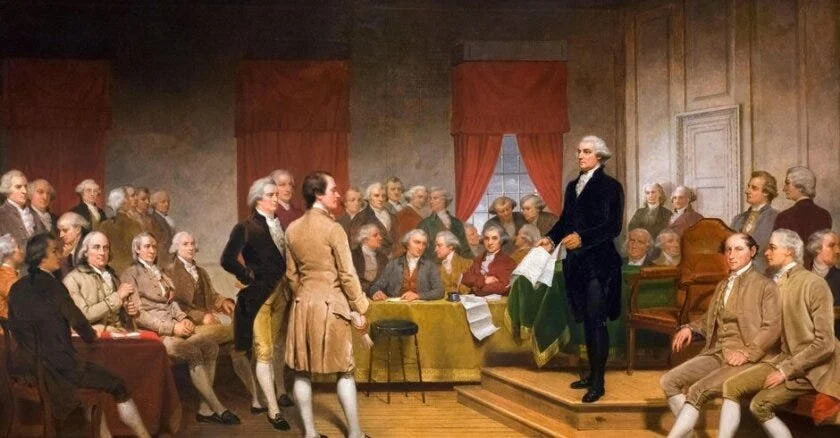
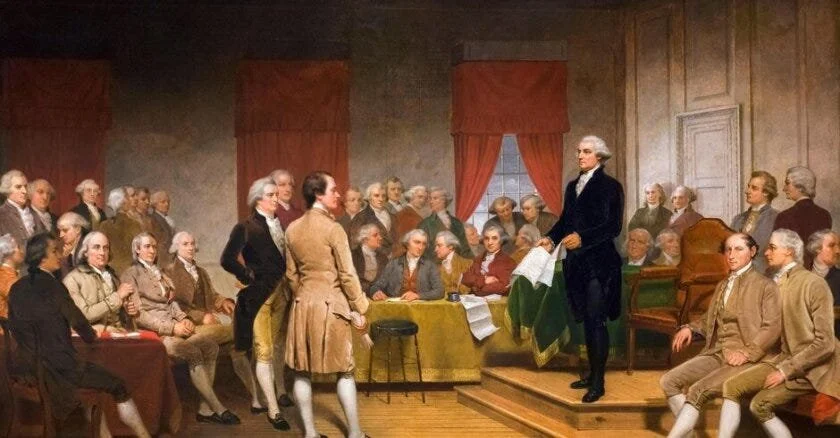
George Washington and the other Founders at the Constitutional Convention
by John Lucas
Virginia Governor Abigail Spanberger has just cemented her place in history as one of the most radical and dishonest governors in the country. She has a lot of competition for that title, but she is doing her best to surpass all rivals for the crown.
One of her latest anti-Constitutional scams is to evade the Constitutional process for electing the President by effectively abolishing the Electoral College, which has been a key part of our Constitution and republican system of government since 1789.
Like her efforts to amend the Virginia Constitution, Spanberger’s more recent abuse does not pretend to benefit Virginia voters. In fact, it has the opposite effect by trashing long-established constitutional rights.
Spanberger and her Democrat lap doggies in the General Assembly are attempting to deprive all Virginians of a fundamental right — the right to have a meaningful voice in the election of the President of the United States when they cast their ballots. If they succeed, Virginians will still be able to vote in future presidential elections but their votes will be diluted by over 150 million voters in the other 49 states and the District of Columbia. And Virginia and Virginians will have no say in policing the accountability of other states’ voter fraud and electoral theft.
They hope to accomplish this by entering into an illegal contract with other states. The contract was embodied an amendment to the Code of Virginia that added three new sections to § 24.2 of the Code of Virginia. Spanberger signed the new provisions into law on Monday, April 13.
The National Popular Vote Compact
The new law purports to discard the Electoral College. It adopts the National Popular Vote Compact. The Compact is a contract between the signatory states that will become effective when enough states have signed it to have their cumulative electoral votes control the outcome of presidential elections. When that 270 electoral vote threshold is met, the presidential electors in each signatory state will not be bound to vote for the presidential candidate who wins in their state. Instead Virginia’s (and the other states’) electoral votes will all be awarded to the candidate who garnered the most votes nationwide.
If, after seeing the line-up of presidential candidates or party nominees, a signatory state then has second thoughts about the wisdom of its decision, it may not withdraw from the Compact within six months of the end of the then-current presidential term on January 20 (or January 21 if January 20 falls on a Sunday).
Here is Virginia’s official summary of the changes:
Presidential electors; National Popular Vote Compact. Enters Virginia into an interstate compact known as the Agreement Among the States to Elect the President by National Popular Vote. Article II of the Constitution of the United States gives the states exclusive and plenary authority to decide the manner of awarding their electoral votes. Under the compact, Virginia agrees to award its electoral votes to the presidential ticket that receives the most popular votes in all 50 states and the District of Columbia. The compact goes into effect when states cumulatively possessing a majority of the electoral votes have joined the compact. A state may withdraw from the compact; however, a withdrawal occurring within six months of the end of a President’s term shall not become effective until a President or Vice President has qualified to serve the next term. The bill also provides for the manner of appointing electors when such agreement does and does not govern the appointment of electors.
Ramifications and areas of concern
There are numerous undesirable ramifications and areas that should be of serious concern to persons of good faith in either political party. Democrats think that the Covenant favors them today but because they know that the provisions cut both ways, they are placing their bets on the chance that this and other devices will cement their objective of establishing one-party rule far into the future. Otherwise, like Harry Reid’s abolishment of the filibuster for judicial nominees, it could come back to bite them. Some of the concerns are:
Timing designed to deprive states of flexibility when they need it most — The last three months before any election, especially a presidential election, are a crucial period. That is when many people who do not follow politics closely begin to pay more attention to political events and news. It is when many voters form opinions about the candidates and make their decisions. But during that critical time if a majority of citizens and legislators in a signatory state decide that a particular candidate is not acceptable, there is nothing that they can do to prevent their electoral votes from being cast for that unsuitable candidate despite the majority’s wishes. That is because a state cannot withdraw from the Compact within 6 months of the upcoming presidential inauguration.
That means that irrespective of its voters’ desires, a state is wedded to the winner of the national popular vote by July 20 or 21, at the latest. [See Footnote 1.]
Consider that in recent times the parties’ national conventions are typically held in late July, August, or even early September. That means that a signatory state’s electoral votes could effectively be bound to the winner of the national popular vote at least 3 1/2 months before election day and even before the states know who the nominees will be.Stealing one of Americans’ most precious rights — One of our fundamental and most precious rights is the right to cast a meaningful ballot to elect the leader of our country. That right, guaranteed by the Constitution, has essentially been stolen by Spanberger and the states that have adopted the Compact.
Meaningless votes — The possibility that Virginia’s electoral votes could go to a candidate rejected by a majority of Virginia voters is real and undeniable. A candidate from either party could win in Virginia by a decisive margin, only to see that victory tossed onto the scrap heap when Virginia’s electoral votes went to the other candidate who has been thumped in Virginia but embraced by wide margins in, say, California or Florida. [See footnote 2.]
Dilution of votes — Virginia’s presidential votes will be allocated, not by its citizens at the polls, but by millions of other voters with the greatest weight coming from the more populous states such as California, New York, Illinois, Texas, and Florida. That is true even if all those states have not entered into the Compact.
Making it even more difficult to do anything about voter fraud and stealing elections — The compact contains no provisions for resolving issues of voter fraud or election abuse of any nature. So if Virginia authorities believe that vote tallies in another state are corrupted by the absence of any controls over over voter identification, or even suppressed by blatant voter intimidation such as club-wielding thugs at poll sites, they still have no choice but to combine Virginia’s electoral votes with those of a corrupt state.
An anti-Constitutional scam — The Constitution clearly contemplates individual states making their own decisions and not submitting to governance by other states with different interests. That is why the Framers gave us a republic. The Compact discards that balance, treating Idaho’s interests as identical to New York’s.
An end-run around the Constitution — The Compact seeks to make a radical change to the method of electing a president that is established in the Constitution. Its “progressive” proponents try to justify but do not hide the fact that they are trying to avoid the constitutional process for making amendments. Amendments cannot be proposed or ratified by popular vote. The amendment process in the Constitution requires 2/3 of both the House and Senate to approve any proposed amendment. A proposed amendment must then be ratified by 3/4 of all states, acting through their legislatures or a convention. Ratification typically must occur within a 7-year time frame. That process, requiring super-majorities of states, not of individual voters, for both proposing and adopting an amendment is a reflection of the Founders’ intent to prevent the “tyranny of the masses.” It is the opposite of the system proposed by Spanberger and the other proponents of the Compact.
The current status of the Blue States’ attempted revolution
With Virginia now on board, the Compact has been adopted by 18 states and the District of Columbia. The adopting states and other information is available here. The signers have a total of 222 electoral votes, leaving them just 48 votes shy of the 270 vote threshold needed to dictate the election outcome.
All of the signatory states voted for the Democratic ticket in the last three presidential elections. There is an agenda here.
There are five states that voted for Trump in 2016, but flipped to Biden in 2020, and then flipped back to Trump in 2024. They are Pennsylvania (19), Georgia (16), Michigan (15), Arizona (11), and Wisconsin (10). None have yet signed onto the Compact. But with a combined total of 71 electoral votes, any four of them could put the rebellion over the top.
If you live in any of those states you should expect a renewed push to pull them into the rebel camp before November 2028.
Even if you live in another state that has not yet joined the anti-Constitutionalist revolution, your state may still be targeted. For example, the state senates of both North Carolina (16 EVs) and Oklahoma (7 EVs) passed the Compact in 2007 and 2015, respectively, as did Arizona’s House in 2016. So those three states with their combined 34 electoral votes also could be prime candidates for a renewed push to add the additional 48 EVs and be able to control the presidential election with the magic 270 EVs. Those states plus either Michigan (15) or Pennsylvania (19) would do the trick.
Look for national money to pour into state legislative races in those states to accomplish the goal of the end run around the Constitution.
The Founding Fathers’ fear of unfettered democracy
If the Compact is fully adopted by the joinder of as few as four additional states, it would move us closer to a nationalized direct democracy. That would realize one of the Founders’ greatest fears. Here is a sampling of their views:
James Madison: “[D]emocracies have ever been spectacles of turbulence and contention; have ever been found incompatible with personal security, or the rights of property; and have, in general, been as short in their lives as they have been violent in their deaths.”
John Adams: “Remember, democracy never lasts long. It soon wastes, exhausts, and murders itself. There never was a democracy yet that did not commit suicide.”
John Quincy Adams: “[T]he experience of all former ages had shown that of all human governments, democracy was the most unstable, fluctuating and short-lived.”
Gouverneur Morris, Signer and Penman of the Constitution: “We have seen the tumult of democracy terminate . . . as [it has] everywhere terminated, in despotism. . . . Democracy! savage and wild. Thou who wouldst bring down the virtuous and wise to thy level of folly and guilt.”
A nationwide popular vote for president does not ipso facto convert our democratic republic into a direct democracy. But the Founders established the electoral system to serve as a bulwark against the prospect of mob rule.
That bulwark is now under attack by the “progressives.”
I say “at the latest” because, as a practical matter, given the time that it would take a state legislature to decide to withdraw from the Compact, the decision to begin the process would have to begin weeks or months earlier.
2. Here and elsewhere I speak in terms of Virginia because that is where I currently live and we are now suffering under the Spanberger regime. But the concerns and problems stemming from the Compact affect and apply to many other states as well.
Richmonder John A. Lucas publishes the Bravo Blue blog. This column has been republished with permission from Bravo Blue and Bacon’s Rebellion.