Big Batteries Lose Big Energy Every Charging Cycle
by Steve Haner
An inconvenient truth of utility-scale battery operations is that they take in more power than they later put out. From an energy grid operations point of view they are considered “net load” and certainly not a generation asset.
In a previous post about the battery mandate legislation now poised for passage in both the Virginia Senate and the House of Delegates, a national energy laboratory was cited as reporting the batteries lose about 15 percent of stored energy on one “round trip”, a charge-discharge cycle. For every 100 megawatt hours stored, they can later discharge 85 megawatt hours.
A local energy engineer then contacted Bacon’s Rebellion to argue that the efficiency figure is worse than that. He came armed with actual performance data on North Carolina and Virginia utility scale batteries from 2020 to 2024, culled directly from U.S. Energy Information Agency public data.
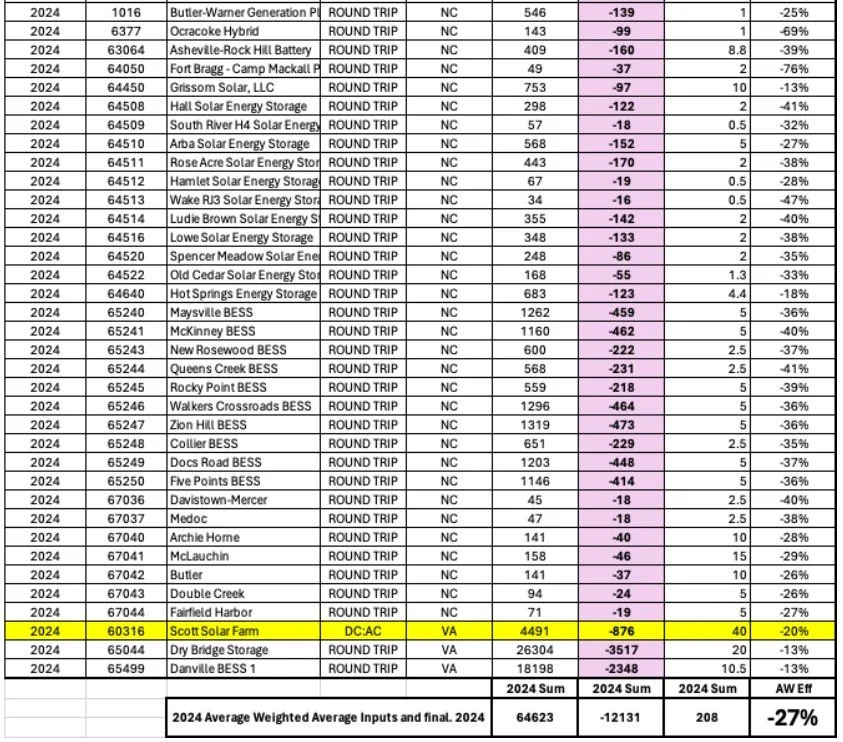
Of the 36 battery installations tracked, 33 were in North Carolina, which is ahead of Virginia in using both solar power and related battery backup facilities. The utilities report to EIA how much power the batteries took off the grid over the year, and how much they put back in when called upon.
These are far smaller batteries than called for in the pending House Bill 895and Senate Bill 448, due for their next votes Monday and Tuesday. They only added up to 208 megawatts total faceplate value, and most were paired with some solar project. But over the course of the year 64,623 megawatt hours of electricity was stored in them, with 52,492 megawatt hours later pulled out of them to support the grid.
Looking at it one way, 19 percent of the power put in was lost. Looking at it another way, it took 23 percent more power to load the batteries than they later discharged. Looking at their results individually and just averaging their performance, the round-trip loss was 27 percent. That is what retired engineer David Tucker, P.E., did on the table below. The 19 percent “power lost” seems the fairest way to look at it and is probably how the national lab did the math.
Over that year, the 12,131 megawatt hours lost during the cycle were enough to power about 1,000 typical homes (at 1,000 kilowatt hours per month). The battery bills call for about 100 times more capacity than was tracked on the 2024 spreadsheet, so does that mean their annual cycles, once built out, will lose enough power for 100,000 homes? Won’t we all have paid for that 1.2 million megawatt hours that went into the batteries but didn’t come out?Even if half that, the narrative that they will be saving us money gets harder to maintain.
Tucker would have made a marvelous witness had the Assembly or one of its committees done a real dive on these bills. Instead, they have sailed through with about the same level of debates that a county charter change might spark. Governor Abigail Spanberger has already expressed her strong support
It is not the legislative ignorance displayed so far that should concern you, it is the apathy. They are passing this on largely party line votes, with most Republicans voting no. But somebody pulled an old but effective trick, and the bill now includes a requirement that some of Dominion’s batteries be installed all the way out in the coalfield counties.
Their Republican legislators are now voting “aye”, and the mandate law will now be defended as “bipartisan.”
The table of 2024 data lines Tucker sent is reproduced below. A clearer version on a spreadsheet, extending back to 2020, can be seen here. He put a negative number in the “energy discharged” column when it might have been clearer to label that “energy not discharged,” the difference between the input and later output. It still gets the point across.