To Understand a Place Like Mississippi
by Bryn Mahan
To understand the world, you must first understand a place like Mississippi. - William Faulkner, maybe.
That line is usually attributed to William Faulkner, though no one can prove he ever said it. I rather like that. Mississippi has produced more than its share of great writers and it seems entirely appropriate that one of the most enduring observations about the place should have a disputed author.
No matter. It's true.
I spent ten years in Mississippi, arriving in Oxford in the fall of 2008 as a freshman at Ole Miss. I knew embarrassingly little about the state when I decided to move there. My parents still love to tell the story of when I finally looked at a map and discovered, to my considerable dismay, just how far Oxford was from a beach.
I arrived knowing no one but during my first week I met another girl from Virginia whose aunt knew somebody who knew somebody and somehow we ended up with two tickets to the presidential debate. So there I was, barely a month into my rather unremarkable academic career as an art major, watching Barack Obama and John McCain debate on my new college campus. Between that experience and an introductory political science class taught by a professor who remains one of my all-time favorites, I was hooked. By spring, I'd changed my major to political science. I've been a political junkie ever since.
My college years stretched on a little longer than intended, owing largely to how much I loved Mississippi and just how much fun a person can have in Oxford. Mississippi has a way of getting into you. I made some of my dearest friends there, had my first child there and developed a fierce affection for a place so often misunderstood by people who have never set foot in it. I still feel protective of Mississippi, though I've never been under any illusions about its faults.
So when Bill Clinton showed up in Tupelo on the Friday before the midterms to campaign for Scott Colom, I thought: Holy shit.
The Democrats' internal polling must have shown how competitive Mississippi was, because they don’t trot the former president out for a lost cause.
Mississippi hadn't elected a Democrat to the United States Senate since 1982. Trump carried the state by nearly 24 points in 2024. Sen. Cindy Hyde-Smith, the Republican incumbent, had been treated as a safe bet.
By the early hours of November 4, Colom led by just 43 votes. For the next week, Mississippi held the country's attention as election officials counted outstanding ballots and the margin crept upward.
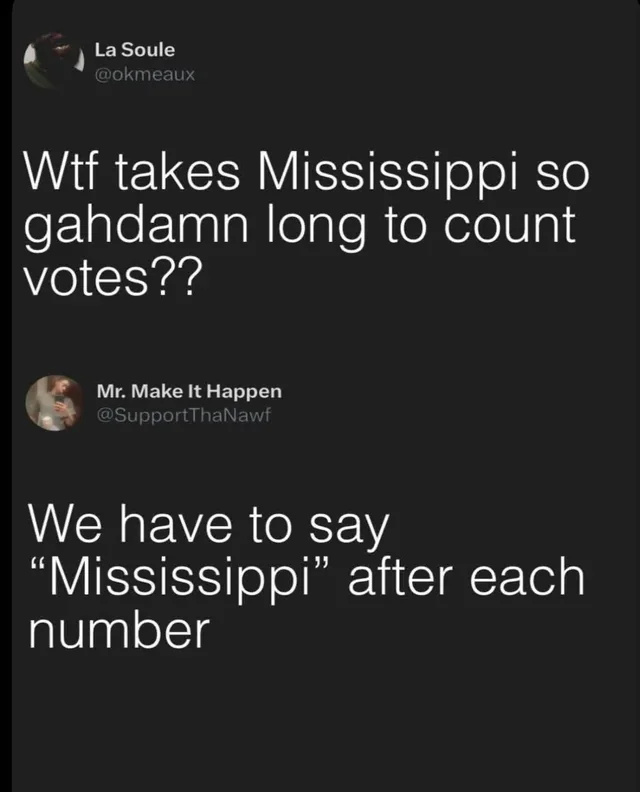
On November 11, the Associated Press called the race. Hyde-Smith conceded. Scott Colom had defeated a sitting Republican senator in one of the reddest states in America, becoming Mississippi's first Black U.S. Senator since Reconstruction.
The Mississippi America Thinks It Knows
Americans who know next to nothing about Mississippi have a habit of using it as shorthand for everything wrong with the country. Poverty, racism, ignorance, obesity, corruption, religious fundamentalism. Pick your preferred national embarrassment and someone will find a Mississippi statistic to illustrate it.
The state's history offers plenty to justify scrutiny. But it is lazy to distill millions of complicated people into a few tropes about racism and public school rankings. Mississippi's contradictions are essential to understanding the Magnolia State.
Mississippi’s deep religiosity and considerable enthusiasm for drinking. Its extraordinary literary and musical inheritance, produced in a place where education was denied to so many for so long. Its humor, its poverty, its capacity for cruelty and astonishing generosity. These things exist alongside one another, in the same town, the same family and even the same person. Generations of Mississippians have had to navigate all of it, finding ways to build lives and communities amid histories and circumstances that are often painfully difficult to reconcile.
Mississippi maintained statewide Prohibition until 1966, a remarkable feat for a state whose residents never seemed particularly committed to sobriety. When I lived there, navigating its patchwork of blue laws was a favorite extracurricular activity. Sunday purchases required crossing a county line. On a football Saturday in the Grove, you could have whiskey but be told to pour out your beer. At baseball games, the beer returned. Keeping track was an education in itself.
Mississippians navigate contradictions so thoroughly ingrained in everyday life that they've become part of the culture itself. Some are amusing, like the liquor laws. Others have had far more painful consequences.
Mississippi's racial and economic history is impossible to untangle. There is no honest way to tell the state's story without acknowledging how deeply race shaped its society and how those divisions benefited the people at the top.
Slavery established a social order in which race determined who owned land, who accumulated wealth and whose labor made that wealth possible. Emancipation threatened that order and the decades that followed saw white leaders use segregation, disenfranchisement, and violence to preserve as much of it as they could.
For poor white Mississippians, the arrangement carried its own contradictions. Many lived in grinding poverty, worked land they didn't own, and had little influence over the political decisions shaping their lives. Yet the racial hierarchy afforded them a status that Black neighbors, living in nearly identical economic circumstances, were systematically denied. That distinction helped sustain political loyalties that often served the interests of wealthy landowners and powerful families far better than those of the people whose votes kept them in office. And it meant that people who might have found common cause in their economic struggles were instead encouraged, and often quite willing, to see one another as enemies.
That history remains woven into Mississippi's institutions and everyday life. The state has changed enormously, in many ways for the better. Across its remaining divisions, people face some of the same frustrations: rising costs, uncertainty about their children's futures and representatives who seem to have forgotten what ordinary life costs.
Those frustrations can test even durable political loyalties. At some point, it becomes difficult to keep blaming your neighbor when neither of you can afford to fill your gas tank.
Cindy Hyde-Smith, Scott Colom, and the Price of Beef
In February, Cindy Hyde-Smith offered a rather spectacular illustration of that disconnect when, asked about the rising price of beef, she explained commodity prices and transportation costs before helpfully reminding consumers that they could always “choose another protein.”
Coming from a cattle rancher, former state agriculture commissioner and sitting member of the Senate Agriculture Committee, the advice was particularly rich. There was also the remarkable political contortion of a woman whose own livelihood is tied to the cattle industry appearing to defend rising beef prices rather than risk breaking ranks with the president. But beneath all that irony was a remarkably casual dismissal of her constituents' struggles over something so deeply woven into Mississippi culture: food.
Good Lord.
It was the kind of political gift Glenn Youngkin received in 2021, when Terry McAuliffe declared during a gubernatorial debate that he didn't think parents should be telling schools what to teach. Youngkin's campaign seized on the remark and made it a centerpiece of his successful run for governor. Five years later, Hyde-Smith had handed Colom a similarly irresistible opportunity. Both politicians had managed to convey the same sentiment: Shut up, you ungrateful peasants. We know what's best for you. Colom's campaign promptly turned her advice into a viral ad urging Mississippians to pick another senator instead.
The advertisement was funny. In a political season when we are bombarded with one campaign ad after another, it was a novelty: one you wanted to watch.
Bill Clinton got in on it at the Tupelo rally.
“I don't believe we need a senator to explain the existence of chicken,” he said.
Pick another protein is a let-them-eat-cake moment. It revealed a distance between the people making policy and the people living with its consequences.
Many Americans seem to be growing furious about that distance.
The ordinary things that once defined a comfortable middle-class life are slipping out of reach. People go into Walmart or Dollar General, stores that practically built their businesses on the promise of affordability, and come out wondering how they spent so much money on so little.
They work, sometimes at more than one job, and still struggle to support their families. They worry about keeping their houses, insuring their cars, and paying for medical care. The expenses accumulate in small, relentless increments.
And they look at their children.
For decades, parents told their kids that if they went to college, worked hard, and earned a degree, they would be rewarded with a good job and a better life.
Many of those kids did exactly what they were told. They took out the loans. They got the degrees. Now many of them are drowning in debt, unable to find work that pays enough to justify the education they were promised would secure their future.
Meanwhile, the culture has changed so dramatically that parents don’t even know how to begin protecting their children from it. Sports gambling follows them around on their phones. Pornography is everywhere. Algorithms have become expert at keeping them distracted, angry, and consuming. The internet is filled with AI slop.
You can't blame these frustrations on one political party or one president. It's been a steady march in the wrong direction and people are beginning to recognize that the institutions they trusted have been remarkably good at collecting their money and remarkably bad at delivering on their promises.
And Trump, who built his political career railing against the very institutions people have lost faith in, now finds himself on the other side of that frustration.
America First was built around a specific promise: Washington had abandoned ordinary Americans and Trump would fight for them. It was a powerful argument, particularly in places where people had watched jobs disappear, communities decline and felt disenfranchised.
Yet at a rally in Georgia on October 24, Trump was discussing the economic benefits he believed the country was receiving from its oil interests and the war with Iran. Anticipating criticism for boasting about national wealth while Americans struggled at the gas pump, he declared:
“I don't give a damn,” he said. “I'm gonna say it. We're making a freaking fortune.”
Imagine hearing that while sitting at a gas pump in Okalona, Mississippi, trying to figure out how much you can afford to put in the tank and still have enough left for groceries.
Whose fortune?
Somewhere along the way, the populist movement that promised to challenge the establishment had begun to sound an awful lot like it. And there was a Mississippi cattlewoman, of all people, telling her constituents to eat something besides beef.
The Man Cindy Hyde-Smith Tried to Keep Off the Bench.
Scott Colom is not the kind of Democratic candidate you'd expect to find at the center of a national media frenzy these days.
Colom grew up in Columbus, Mississippi. His father, Wilbur, is a Republican attorney who worked for Ronald Reagan; his mother, Dorothy, became a pioneering Black chancery judge. He studied English and history at Millsaps, went to law school at the University of Wisconsin and returned home to practice law.
In 2015, he defeated a longtime incumbent to become the first Black district attorney elected in his majority-white judicial district.
A prosecutor who supports the Second Amendment and stronger border security, he also opposes gender-affirming surgery for minors and biological boys competing in girls' sports. During his Senate campaign, he traveled to all 82 Mississippi counties, even showing up at a Trump rally to talk with supporters waiting in line about what mattered to them. His campaign was energetic, often funny and focused on the everyday concerns of Mississippians rather than the usual partisan grievances.
Colom has spent much of his career navigating Mississippi politics where personal relationships do not always align neatly with national party loyalties.
In 2022, President Biden nominated him for a federal judgeship in Mississippi's Northern District.
His supporters included law enforcement officials, the Magnolia Bar Association, the NAACP, Republican Rep. Trent Kelly, Senator Roger Wicker, and former Republican governors Haley Barbour and Phil Bryant.
Cindy Hyde-Smith did not join them.
And here, three years before they would face each other on the ballot, is where the trouble between Hyde-Smith and Colom began.
Hyde-Smith refused to return what is known as a blue slip, a Senate Judiciary Committee tradition dating back more than a century. When a president nominates someone to a federal judgeship, the committee sends a blue form to both senators from the nominee's home state, asking whether they support moving forward. At the time, either senator could effectively kill a district court nomination simply by refusing to return it.
Hyde-Smith cited outside campaign spending linked to George Soros and accused Colom of opposing protections for female athletes. But the statement she relied on concerned transgender rights and healthcare, not women's sports.
The Soros-linked spending had supported his district attorney campaign through an outside political committee. Colom said he hadn't solicited it or known about it until it was reported.
And because Mississippi has a peculiar talent for making its past impossible to escape, one historical footnote about those blue slips is worth mentioning. In 1956, segregationist Senator James Eastland helped turn the practice into an effective one-senator veto, reportedly to keep judges sympathetic to desegregation off Southern federal courts. Nearly seventy years later, another Mississippi senator was using that very same tactic to keep a Black Mississippian off the federal bench.
Eastland would have appreciated the procedural efficiency.
That history doesn't establish Hyde-Smith's motive. It does give her choice of instrument an uncomfortable local pedigree.
There's one more detail about Colom's failed nomination that is too fun, too Mississippi to leave out.
The federal judge he was supposed to replace, Michael Mills, had already taken senior status, a sort of judicial semi-retirement, but was still carrying nearly a full caseload while he waited for a successor. Mills had other things he'd rather be doing. Namely, playing guitar.
As Bobby Harrison reported in Mississippi Today in June 2023, Mills played rhythm guitar in a band called June Bug, named for an annual gathering inspired by Bobbie Gentry's “Ode to Billie Joe,” the wonderfully morbid Mississippi classic about a young man jumping off the Tallahatchie Bridge on June 3. The band included some serious musical talent: Will McFarlane, who played with Bonnie Raitt, on lead guitar, and Billy Earheart of the Amazing Rhythm Aces on piano.
On vocals: Roger Wicker, the Republican senator who supported Colom's nomination.
Mills told Harrison that once his replacement was confirmed, he might take the band on the road.
Unfortunately for Mills, Hyde-Smith's objections kept him on the bench and Colom off it.
Three years later, Mills was still waiting to retire, and Colom was running for Hyde-Smith's Senate seat.
She'd had the power to keep him from becoming a federal judge.
Three years later, Mississippi voters gave her a pink slip instead.
How Scott Colom Won Mississippi
Colom didn't need Mississippi Republicans to become Democrats. He needed enough of them to decide that Hyde-Smith wasn't doing the job they'd sent her to Washington to do.
The county returns were striking.
In 2020, Hyde-Smith carried DeSoto County, just south of Memphis, by sixteen points. Trump won it by 24 points in 2024. Yet Colom won DeSoto by roughly seven points. That's a shift of about 23 points from Hyde-Smith's last election and 31 points from Trump's victory just two years ago.
The shift was not necessarily a political conversion. DeSoto had changed considerably, its growing population bringing new voters and new loyalties. And presidential elections are different animals from midterms. In 2024, Donald Trump received more than 48,000 votes in the county. Two years later, Cindy Hyde-Smith managed barely half that number, while Colom drew slightly more votes than Kamala Harris had.
Whether Republicans stayed home, Democrats turned out, or voters crossed party lines, the result was unmistakable.
DeSoto wasn't alone. Colom also flipped Lafayette and Madison counties, and performed competitively in other places where Republicans had long counted on comfortable margins.
It was an extraordinary result in a state that had not elected a Democratic senator in forty-four years. But Mississippi was hardly alone in its discontent. Across the country, voters were expressing frustration with an economy that seemed to work for everyone but them. In the Associated Press's national voter survey, seven in ten Americans said the economy favored the wealthy over ordinary people.
Pundits will dissect the national results as a referendum on Trump or a Democratic resurgence. But Mississippi's election raises a more immediate question: How much longer are people willing to accept so little from the politicians they keep sending to Washington?
Mississippi's Rural Hospital Crisis
The deterioration of rural health care offers a particularly grim example of what Mississippians have been getting in return.
The Mississippi Delta is among the poorest and least healthy regions in the country. Diabetes, heart disease and other chronic illnesses are widespread, while the doctors and hospitals needed to treat them are disappearing.
Greenwood Leflore Hospital, which has served the central Delta for more than a century, came perilously close to closing this spring. In April, it laid off 86 employees, eliminated services and filed for bankruptcy. Its intensive care and labor and delivery units had already been shuttered. The University of Mississippi Medical Center eventually took over operations in August, but not before the community spent months confronting the possibility of losing its hospital entirely.
For patients around Greenwood, alternatives can mean traveling more than thirty miles to Grenada or ninety miles to Jackson. The hospital also serves communities like Belzoni, which lost its own hospital in 2013. Another closure would leave an enormous stretch of the Delta even farther from medical care.
The trouble didn't begin with Greenwood Leflore, or even with the current administration. Mississippi has refused to expand Medicaid since the Affordable Care Act took effect, despite the federal government offering to cover 90 percent of the cost. The result is a peculiar predicament in one of America's poorest states: working adults too poor to qualify for subsidized marketplace insurance, yet ineligible for Mississippi's restrictive Medicaid program.
Hospitals still have to treat emergency patients who cannot pay. Expanding Medicaid wouldn't magically solve the crisis, but it would mean fewer unpaid bills and more federal dollars flowing into a health care system that desperately needs them. In 2024, Mississippi's Republican-controlled House even passed an expansion proposal, only for negotiations to collapse in the Senate.
Then came Trump's One Big Beautiful Bill, signed into law in July 2025 with Hyde-Smith's support. The legislation cut projected federal Medicaid spending by roughly $1 trillion over ten years, with the Congressional Budget Office estimating that its Medicaid provisions would leave millions more Americans uninsured. Republicans argued the changes would curb waste and preserve the program. The law included a $50 billion rural health fund, but offered little immediate comfort to hospitals already operating on the edge of insolvency.
Colom campaigned on reversing Medicaid cuts, restoring private insurance subsidies and encouraging Mississippi to expand Medicaid. He talked about keeping emergency rooms open and sparing families an hour's drive to a hospital.
There are legitimate disagreements about how much government ought to spend and whether these programs deliver what their supporters promise. But the consequences of Mississippi's decisions are no longer hypothetical. They can be measured in uninsured patients, shuttered maternity wards, exhausted hospital budgets and the miles separating sick people from the care they need.
What Mississippi’s 2026 Senate Election Means
There is something hopeful about watching people who have voted one way for years decide that their loyalty is not unconditional.
The American experiment depends on that willingness. The people who govern us are supposed to answer to us. We are not supposed to become so accustomed to disappointment that we stop expecting anything better.
For much of the last decade, Americans have been told that every election is an existential struggle, that the other side represents an intolerable threat, and that voting for anyone but your party's nominee amounts to surrender. It's an effective way to keep people voting for politicians who have given them very little reason to vote for them.
Mississippi has lived with variations of that arrangement for generations.
And then, on November 3, something remarkable happened.
A state that Donald Trump carried by nearly twenty-four points elected a Black Democrat to the United States Senate. Not because its history had suddenly disappeared, or because all those old political loyalties had evaporated, but because enough people decided they were willing to break with them.
I don't know whether Scott Colom will prove to be the senator his supporters hope he will be. Politicians have a long history of disappointing people, regardless of party. He may well disappoint them, too.
But that is the point.
Mississippians have reminded the rest of the country that political loyalty is earned, not inherited. That the people who hold public office are not entitled to keep it simply because they've convinced us the alternative is worse.
For years, Americans have watched their institutions fail them, their costs rise and their politicians explain why they ought to be grateful for whatever they're getting.
There is a certain satisfaction in imagining a Mississippi voter looking at the political establishment, considering the last several years, and deciding:
Dammit. Do better.
And this time, enough of them did.