Stacking the Deck for Dems and Incumbents
The mechanics of Virginia’s proposed mid-decade redistricting create obstacles for underdogs running for Congress.
by Ken Reid
There are various reasons for defeating the April 21 referendum to allow the Democrat-controlled General Assembly to redraw Virginia’s 11 U.S. house districts to give them a 10-1 advantage vs. 6-5 in the Nov. 3 congressional midterm elections.
One issue, which has gotten scant attention, is the confusion caused for candidates who want to run for House of Representatives.
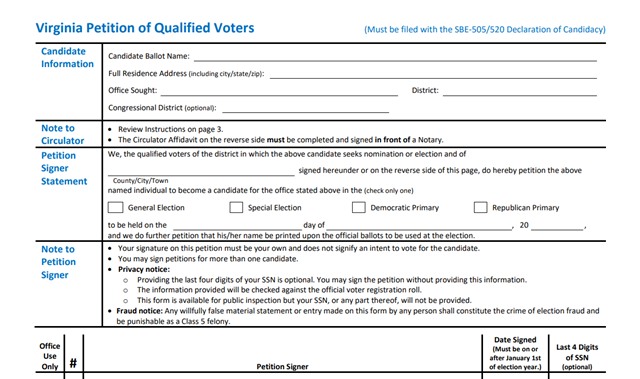
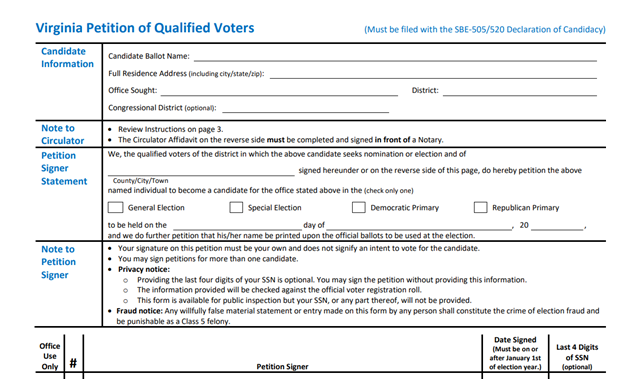
Under Virginia law, to qualify to run for U.S. House, a candidate must, in part, secure the signatures of 1,000 qualified voters of that district on double-sided paper petition forms.
Well, who knows what the districts will be?
Democrats think they solved that with a provision inserted into House Bill 29, a budget bill, which extended the June primary to August 4, and petition and filing forms deadline to May 26. Governor Abigail Spanberger signed it into law.
In addition, HB29 grandfathers signatures candidates gathered before April 21 in the existing House districts. The law reads, “a signature collected prior to the date that the results of the April 21, 2026, special election are certified shall be accepted and be counted towards the required number of signatures if it is the signature of a qualified voter of the Commonwealth.”
This means if the referendum passes, any signatures gathered after April 21 must be from residents of the district where the candidate is running. There is no requirement for candidates to live in the district they wish to run in, but signatures must be from “qualified voters in the district” if gathered after April 21.
This is not so easy.
For one, candidates seeking to be on a Republican or Democrat primary ballot have their petitions and filing forms reviewed by the district committee of their respective party, not a local registrar or the State Board of Elections.
Because candidates cannot file petitions until May 1, this means the district committees have only 25 days to verify the signatures and addresses are valid. According to Ballotpedia, seven Democrats and five Republicans are interested in running in the 7th district, yielding 7,000 and 5,000 signatures, respectively, that have to be reviewed by volunteers in 25 days.
It would have been wise to allow candidates to file whenever they gathered the 1,000, but my guess is the Democrats devised these tight deadlines to thwart competition.
I had a text exchange about this with Julie Perry, who is running for U.S. House in the 10th as a Republican.
She has 600 signatures of the 1,000 needed and is concentrating on Loudoun because the county is entirely in the old and new 10th.
However, she said the uncertainty over districts “is having a massive impact on fundraising. People are hesitant to donate.” But she says she is fortunate she has volunteers in Loudoun to gather signatures and is about to hire some folks to help.
Hiring professional firms to gather signatures can cost thousands. If you have never carried petitions for a candidate, as I did for myself three times, and other candidates, you do not know what a challenge this can be.
I conservatively estimate it can take 5 minutes per voter to explain why they are signing and getting them to sign, date it, provide their address and last four digits of their Social Security number (which is voluntary). Multiply that by 1,000, and you’re looking at 83 hours of time. And this doesn’t include the time wasted on people who won’t sign your petitions out of fear they will wind up on promotional lists, or won’t sign because they don’t know enough about the candidate. Many won’t sign a petition for the opposite party’s candidates, although it’s not a vote.
As such, there is a very high refusal rate in this exercise.
Given the May 26 deadline, it will be hard for many candidates to qualify for the primary ballot, except incumbents and challengers with money. Ballotpedia lists a number of announced candidates; no Republicans for the 3d and 4th districts.
I have to believe the Democrat chieftains in the General Assembly who cooked up this gerrymandering were fully aware these deadlines would discourage people from running for office, particularly Republicans and would-be challengers to Democrat incumbents.
The other problem is this – if the redistricting passes, millions of Virginians will have to get new voter registration cards—costly given we have 6 million registered voters in the state.
Finally, the Democrats claim this is all about “fairness” to counter the mid-decade gerrymandering by Texas and other red states to give Republicans an edge in House races.
But what is fair about dividing Fairfax and Prince Wiilliam County into five House districts and giving them that much clout in Congress at the expense of the rest of Virginia?
Fairfax County has 1.3 million residents, but it has never been divided into more than three congressional districts.
Prince William County is only slightly larger in population than Loudoun County or Virginia Beach, but under the Democrats’ map, Loudoun remains entirely in the 10th and Virginia Beach entirely in the 2nd. Richmond city is divided into the 3d and 4th districts under the redistricting, thus giving that city of only 200,000 two representatives. How fair is this?
It sure would have been nice if the State Supreme Court had decided on the legality of the April 21 referendum before it went to the voters.
Ken Reid, a resident of the Tysons/Falls Church area in Fairfax County, served 10 years in local elected office in Loudoun County and in recent months has been fighting antisemitism in the DC region as DC/MD/VA chapter leader for the group, EndJewHatred.com.
Republished with permission from Bacon’s Rebellion.